

“Every woman deserves at least 10 years of widowhood”
— My mother-in-law’s group chat
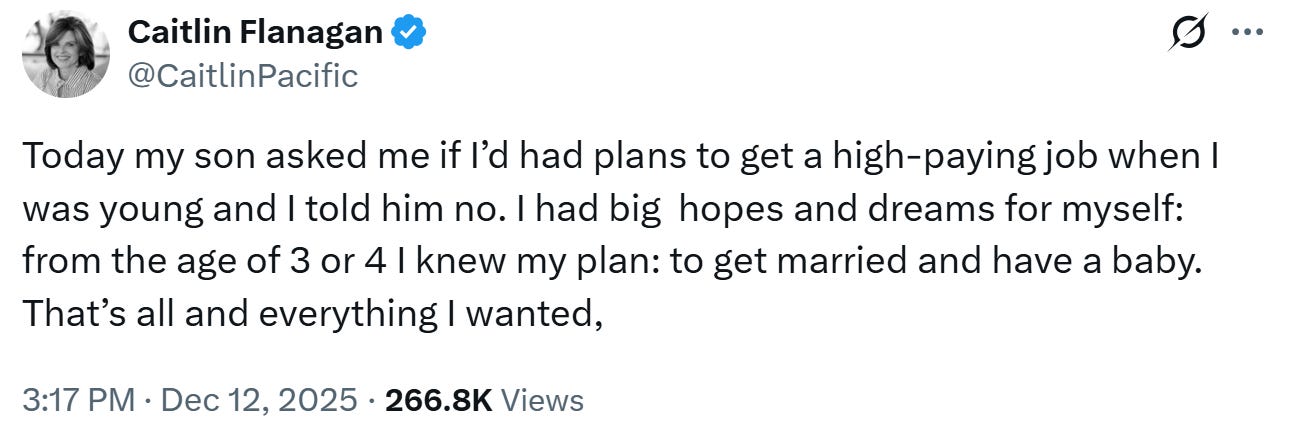
A friend of mine — a mother of three — told me recently: Thank God I never have to go back to work. Another told me that women were sold a story about the careerist lane. Why on earth would you want to burn decades of your life on corporate status games or relentless career pressures when you can create life and nurture it at home?
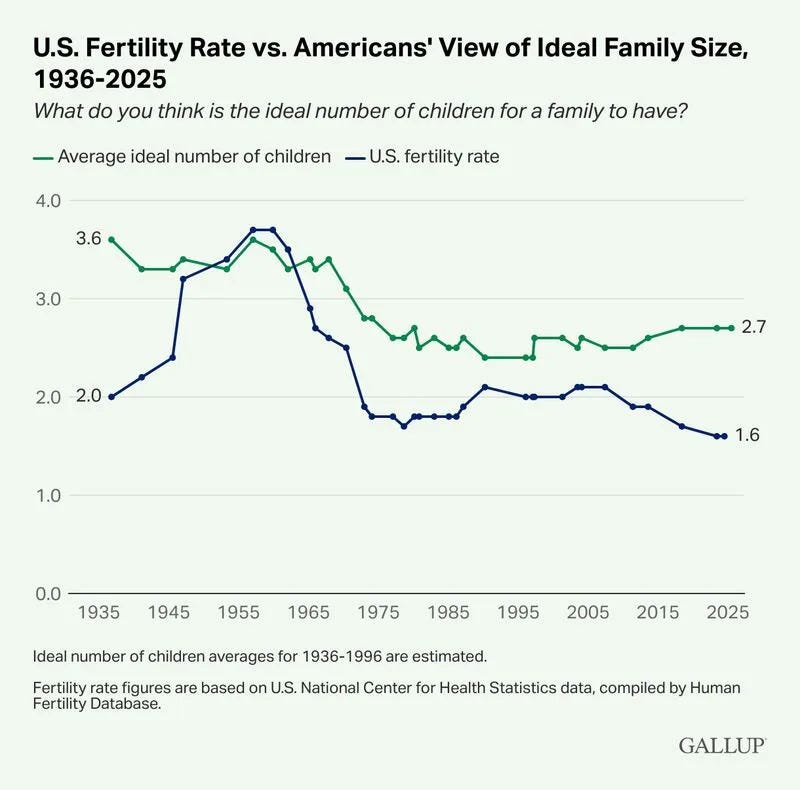
Yet many women have chosen that path and whilst polls consistently show they’d like to have more kids than they do, they must have their reasons. And they do — very good ones.
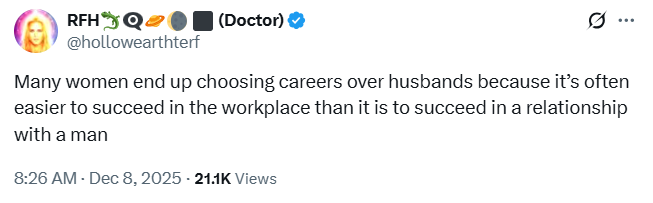
Independent careers are insurance against bad husbands.
First, good careers and education are valuable in the dating market — they make it easier to find a good husband. The prince does not marry the pauper. The investment banker does not marry the pretty waitress. Most marriage is intra-class. Harvard students marry each other. That’s in large part the point of Harvard.
Second, an independent career is insurance against a marriage gone bad. If you are 35 or 45 or 55, have never worked, have dependent children, and your husband becomes abusive — what on earth are you to do?
Wives in this position are deeply vulnerable. Reliance on a single breadwinner is great when it doesn’t break down. But it breaks down all the time. Men fail constantly. Men are degenerates.
And so women’s desire to insure against bad men is roughly proportional to the badness of men. If women looked upon men and saw that they were good, they would not need to spend decades on degrees and work they despise. And yet many do.
There was once a social arrangement — the family unit based on a division of labour. The men worked and the women raised children and made the home. Without contraception, it worked to create a society in a messy way. It was often a raw deal for women. Domestic work could be brutal and she was vulnerable to bad husbands. And there were many bad husbands because there are many bad men. But there just weren’t that many options: she dated local men, there was no reliable contraception, and she was barred from alternative pathways. It was a forced matching and procreation function and she suffered what she had to.
Now women can live quality lives independent of men. They can be in relationships and prevent pregnancy. They can pursue careers and financial independence. Women avoid bad men. By definition, the point of financial independence is to not rely on a man for money. So that if a marriage goes to the dogs, she can stand up. This is all commendable and perfectly rational.
The problem is it breaks the messy, often painful, pro-natal social arrangement that existed before. It’s great that women are no longer forced to be indentured servants to bad men. Hopefully we find an alternative pathway for them to also have the children they’d like. But I wouldn’t count on improving the portion of bad men women are insuring against (20%? 40%? 60%?).
Careers can be fulfilling in ways that are not about insurance against bad men of course. But they can also be a terrible trap. What happens when the cost of insurance against a potentially bad husband is not having a family at all?
I was recently at my cousin’s kid’s birthday party. He’s a doctor. His doctor friends were there. They were in their early 40s and didn’t have kids. My brood were running around. They said they’d like to have children. I asked my cousin afterwards about it, and he said the medical training and career pathway is brutal and very few of his peers had kids and it was now getting too late.
I know a few very successful female surgeons in their forties for whom not having kids is a grave and constant source of anguish. They waited too long, their expectations of life and career and their aspirations for motherhood lived in parallel realities until they collapsed into one final, grim timeline.
It would be a terrible shame if pathways like medicine effectively acted as a fertility incinerator for brilliant women.
The problem with this idea is that men's badness has trended down, but women have still become more career focused. I think the strong focus on "what if a man becomes abusive" is a significant part of the problem in that it stokes anxiety, regardless of the actual risk.
Not only that, but marriage has largely fallen among women with the lowest incomes, and fertility is lower with higher SES.
I think this is a clever idea, but doesn't seem to explain everything we're seeing.
“Men fail constantly.” Unfortunately the human condition. “Men are degenerates.” Can be, but I know many who are not. I am a senior, been married 55 years now. Four kids, married, ten grandchildren, one great grandson. We have many friends with a similar history. Perhaps fewer or more kids and grandchildren. Our wives raised our children and when the last one started attending jr.high, went to work outside the home. Some like my wife went on to university and careers afterwards. We both had what we wanted and needed. I should add that all these families, including ours, had a common faith and church experience. Our children and their spouses are following the same trend. By example I hold out hope for the younger generation.