

The girl in the stars-and-stripes mini-skirt leans out.
She elicits the sympathy of the entire world by revealing
The touching forethought of a sudden matching thong.
…
I am a small god made of terracotta, trembling on a pedestal,
Interred in a maelstrom of sound.
Look what the little clay god has found, neatly folded!
A jumbled bundle of young black bones,
Secured by a teeny half-digested thong.
— Nick Cave, The Sick Bag Song
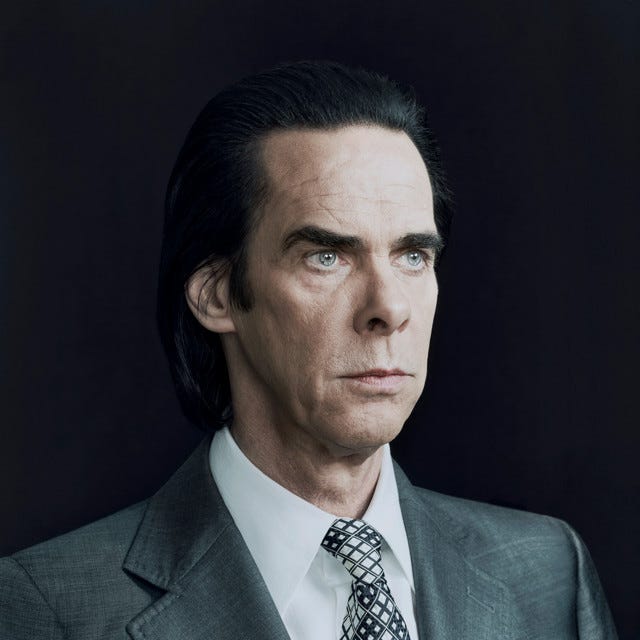
Nick Cave is Australia’s John Milton, and The Sick Bag Song is our Paradise Lost. Its epic form and lyricism are not the story of the Fall, but of a godling flittering about the vast American continent amidst its ghosts and detritus, lonely, masturbating in hotel rooms. Pretzels the size of severed heads. High grass prairies. The ghosts of the Cheyenne. A black girl in a stars-and-stripes mini-skirt and matching thong who stalks and winks at you.
Across this land Cave takes the form of many things. He is a deity on stage. He resists the liver spots that glare in the brutal bathroom light, lacquers his black hair atop his “multi-storied forehead”, and transforms into any number of decrepit gods past: Elvis Presley’s belly rolled up a hill in Sisyphean futility; a Johnny Cash overdose; a Patti Smith hellscape.
Or maybe The Sick Bag Song is our Beowulf, and Cave its lost storyteller. Where in Beowulf our hero seizes the giant-forged sword in Grendel’s mother’s lair and swings it in an arc to break through the bone-rings of her neck — “severed it entirely, toppling the doomed house of her flesh” — Cave might rather do the same to his own forehead. But in The Sick Bag Song Beowulf’s great dragon is reduced to a small one Cave finds beneath a bridge. He doesn’t battle it, but instead examines its sexual organ, and carries its corpse to the river to lie with his drowned gods.
Cave is a mythmaker. For him all memory is myth, the stories we tell ourselves about the past are fraught and unreliable, and so why let them stale, why not inflate them with grandeur, insert new heroes and others’ tales? He inflates the barren world he fled in regional Australia with the grandeur of mythology. He comes from Wangaratta, a town I only know of because a pretty girl I once met was somehow related to a murder-suicide there. The misbegotten ghosts of his Wangaratta youth stalk him.
Part of the magic of The Sick Bag Song is that Cave’s lyricism is unconstrained by music. He can be a lot in interviews, but he pulls it off — he is Nick Cave after all. His central conceit is blasting through Australia’s allergy to tall poppies. The hero Australia deserves. He’s a singular individual, inflected with Christianity and grandeur, a rare combination, both marginalised by Australian society. And yet his grandeur and self-mockery are inseparable. It’s Cave himself who inverts the epic poem genre into some smaller Australian grotesquerie. But then there are moments where his lyric bravado cracks into something raw. His son’s death is still ahead, but loss is everywhere in his work. Desire. Loneliness. We forgive the godling his posturing.
Cave’s inversion of the epic poem is very Australian but it could still only be written among the ruins of a grand America, scrawled across the back of sick bags flying around on tour. Australia’s own epic is yet to be written. Voss’s star-spangled desert night and Aborigine-suckled dingo pups was a step in this direction, unfulfilled. Mr Inbetween points to the bodies buried across the vast outback, and the contours of our yearning, but shrinks from the epic. Australians are allergic to the epic. Our continent still waits for its epic tale to do it justice.
Of course, you must listen to the audiobook where Cave reads it himself. Hear him remember another man’s dreams or inspect his ageing face before roaring onstage, immortal.
This piece captures a part of what I admire in him, congruent to what you seem to identify as well: https://www.theredhandfiles.com/film-festival-berlin-wim-wenders/
As for having him read this, maybe just ask him to comment on it: https://www.theredhandfiles.com/ask-a-question/ ?
I love Nick Cave. I am interested in your take on Swagger Lee, though!