

The Nick Cave / Paradise Lost essays will continue until morale improves.
You’re telling me you haven’t watched Australia’s Blood Meridian, starring Guy Pearce and written and scored by Nick Cave?
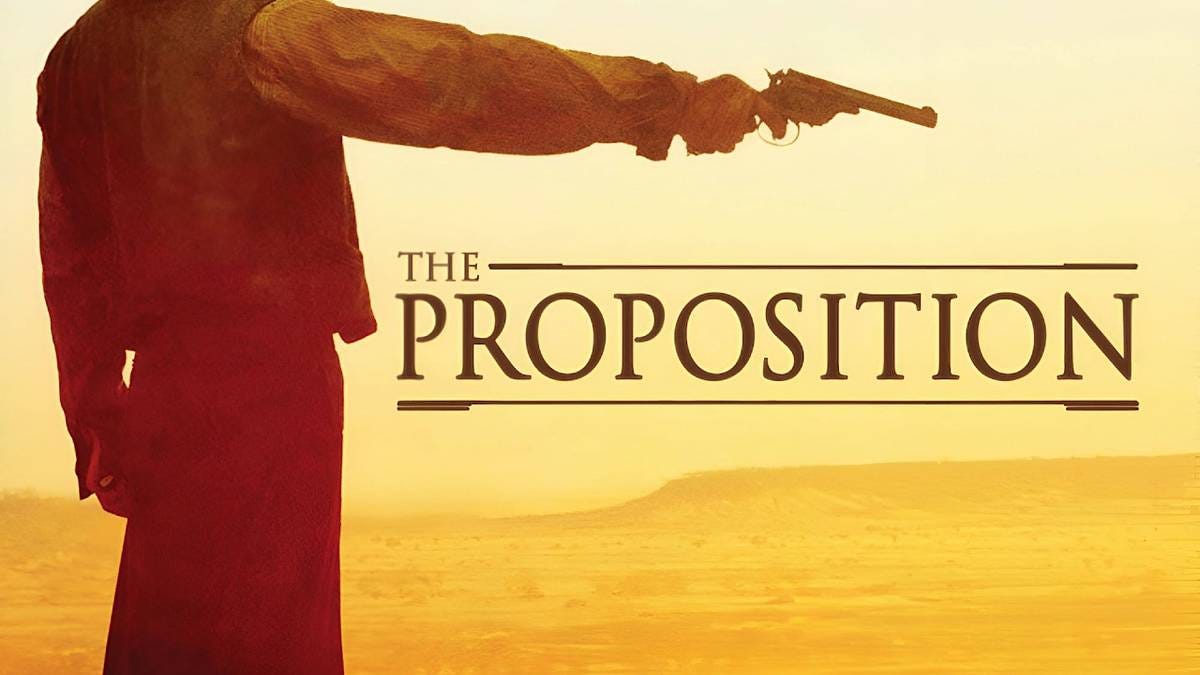
SPOILERS
A shoot out in a whorehouse. Its fiends scrambling frantically as bullets pierce its tin shed walls, the arrows of light illuminating the whores and their criminal customers within. The cops have ‘em.
So begins The Proposition, the agents of light descending on their demonic prey. Milton's war in heaven relocated to a tin shack in Queensland, the rebel angels caught mid-rut.
“What fresh hell is this?” says the captain of this victorious vanguard, sweating profusely as he stares out across the hot plains. He has been sent on a civilising mission from above. But how does one civilise hell, he wonders. He must drag the lower provinces into the light by force, and the force will blacken him.
The equivocal hero of our tale is Charlie Burns, played by an emaciated outback Guy Pearce. In the whorehouse he is caught with his beloved younger brother. In exchange for Mikey’s life — who will otherwise hang on Christmas day — our captain offers him a proposition. To find and kill his older brother, the rapist and mass murderer Arthur Burns.
This is the condemned nature of our hero’s quest. A life for a life. Redemption at the point of Cain’s stain. To strike down his guilty older brother to save his imbecile younger one. Cain killing Cain to save Abel.
Arthur Burns is a Judge-like monster from Blood Meridian. Eloquent, erudite, demonic. He will finish your poem before garroting you. He recites Yeats at sunset from a rock above the plains, a fallen angel addressing the void. Arthur in his hill fort is Satan on Niphates’ top, surveying Eden, soliloquising. Which way I fly is hell; myself am hell. He will rape a pregnant woman before murdering her and her family. He has read more than you have. He has thought more than you have. He has killed more than you have. A vampire at the firehose of life.
But Arthur is not the Judge. The Judge is too nihilistic for Cave, too invulnerable. The Judge cannot be killed because the Judge is not a man. He is the war that rides forever, dancing naked in the saloon at the end of history. Arthur has a soft spot. He is tethered to the earth. He's a brother, and only a brother can kill him. Cave believes in the wound. He believes love is the door through which death enters. The Judge has no door. Arthur has a door, and his brother walks through it at sunset with a pistol.
Arthur has built a kingdom in the hills, a Pandæmonium of one, and he sits in it reciting verse and watching the sun set, and his brother climbs up to him and the kingdom ends.
The land these figures stalk is the epic vastness of Australia, her burnt-out trees and sandy gullies. Above them countless stars. The living are half-dead. Flies swarm the dead and the half-dead alike. The cops are made of the same grit-mutt stuff as the fiends they hunt. (The cops joke-fantasise about ravaging their boss captain’s wife; a dark prophecy the fiends fulfil.) The desert is this country’s grim theology. A landscape that does not care, reducing men to insects crossing a pan.
The Proposition is stuffed with Australian blacks. Blacks are cops and criminals, free and wild, hunters and hunted. They are the only people in the film who seem to belong to the country rather than be punished by it. Just men like everyone else. Or whatever passes for men in these hellish ravines.
The captain’s wife is Eve, tending her English garden in this barren hell. She is desperately lonely in this flimsy oasis. What hubris — the idea that you can plant a rose bush in a furnace and expect it to bloom without watering it with blood. She insists on Mikey’s flogging. She demands vengeance and tastes of the red blood of Mikey’s back and the red blood of the lash, as Eve of the apple. She faints. Eve too is in the end repulsed by her sin. Their Garden is overrun. She is punished.
There is a kind of twisted justice meted out in these parts. When the imbecile Mikey is flogged to death, our good captain knows death will fly to them on wings of vengeance. It was not his doing, but he will bear its justice. Just as Mikey bore theirs. And so on Christmas day, as they wear the trappings of a far away land, a half-forgotten heaven in England, the captain and his wife pray. She says grace. For what we are about to receive, may the Lord make us truly thankful. A dark sense of humour, as they are suddenly descended upon by ravenous demons.
As the demons scourge and rape, our strange hero enters. No more, Charlie Burns says, as he shoots Arthur and his lackey. They stumble out. He sits beside his older brother at the setting of the sun as he bleeds to death. No more.
One of the great Australian films imo.
i remember this being good, need to revisit