

“And thus an old idolator at heart, he yet lived among these Christians, wore their clothes, and tried to talk their gibberish. Hence the queer ways about him, though now some time from home.”
— Moby Dick
When Jack Skellington, the Pumpkin King, stumbles through a magic door into Christmas Town he stands in the snow and looks around at this bright, warm, incomprehensible world.
What’s this? What’s this? There’s colour everywhere.
He has no word for “presents” or “snow” or “cheer”. He knows fright, he knows screams, he knows the artistry of the macabre. And now he’s standing before a world that operates by a completely different grammar. Before this world he is illiterate.
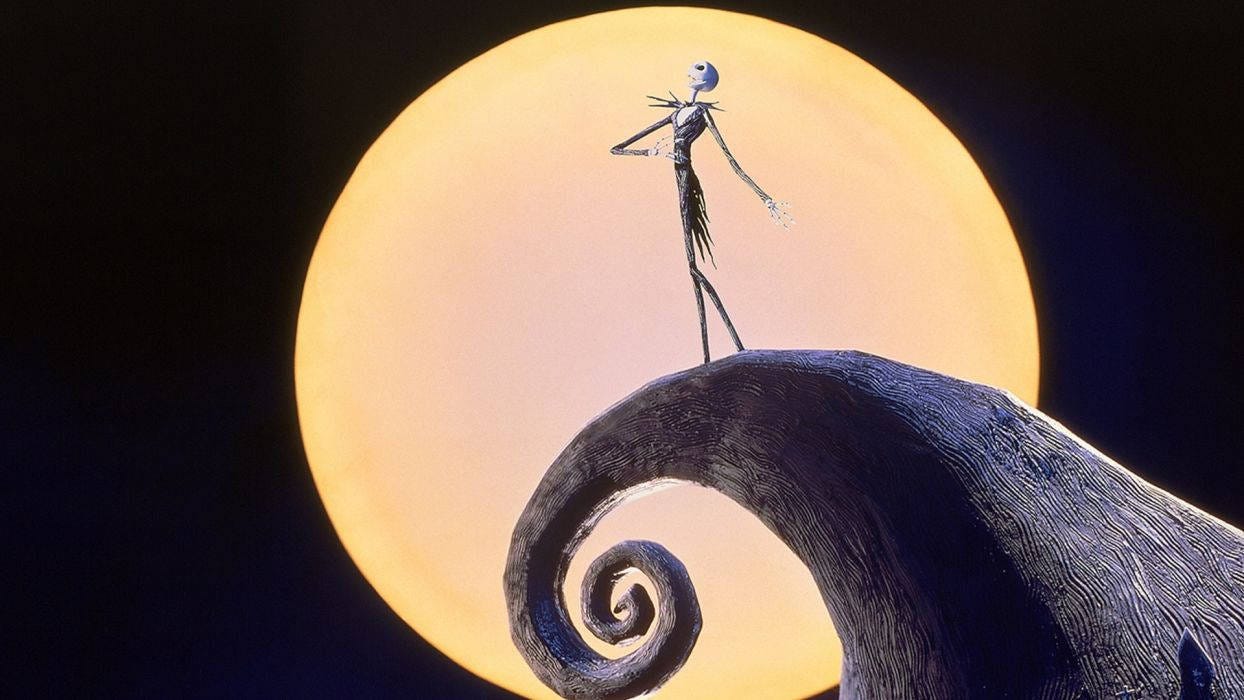
The Nightmare Before Christmas is the greatest film ever made about cultural illegibility. Its hero is one of the best Nietzschean Supermen we get on screen. Jack is great because he cannot help but reach for what lies beyond his ken. And the film’s genius is leaving those two worlds unbridged. Jack fails to understand Christmas Land. He is, in the end, a creature of Halloween. We are what we are. And look how drawn we are to men who reach for more.
In his gorgeous opening lament, Jack is not tired of being great. He is tired of being great at something he has completely mastered. Halloween is solved. There is nothing left to discover within its walls. The ghoulish citizens adore him, the scares are immaculate, the whole operation runs like freshly cut guillotine. And because it is solved, it is dead to him. This is the ache of the man who stands at the precipice of the world he has conquered. Napoleon in Egypt, staring at the pyramids of a civilisation whose hieroglyphs he could not read. Cortez at the edge of Tenochtitlan, confronted by a golden city on a lake. Alexander weeping because there are no more worlds to conquer.
—
Everything Jack sees in Christmas Town is distorted in translation. The presents wrapped under trees are enigmas. Snow is “white things in the air.” He may as well be speaking in a Zizekian or Borat accent: his jaunt parodies the immigrant experience.
Back home, Jack dissects Christmas. He pulls ornaments apart. He reads. He measures. It doesn’t work. He ends up more confused. The ornaments yield no secrets on the dissection table. The candy cane, sliced open, reveals nothing about why it makes children smile. You cannot reverse-engineer someone else’s civilisation from its artefacts.
The Skeleton King enlists the Halloween Town citizens into making presents. Yet everything they produce is an abomination — shrunken heads for gifts, a severed hand poking out of a box, a snake eating the Christmas tree. His own supervision is misguided too — no, he complains about a bit of roadkill being wrapped as a gift, It's been dead for much too long; try something fresher.
Yet the gifts Jack delivers to children are genuine treasures in Halloween Town. A shrunken head is a masterwork of his civilisation’s art. He is not giving junk. He is gifting the cultural equivalent of gold, frankincense and myrrh. His abominable followers are doing Christmas as they understand it. They have applied their own aesthetic vocabulary to someone else’s celebration and produced something that would make the recipients scream — which is exactly what Halloween is supposed to do. They have succeeded perfectly by their own standards while failing catastrophically by their adopted culture’s.
This is the immigrant community that has adopted the festivals of the host country and produced something that looks, to the natives, uncanny. It is what happens when a civilisation tries to absorb another’s institutions wholesale: you get the forms without the meaning. The Christmas tree with a snake in it. (Ironically, what is Christmas itself if not some abominable offspring of Christian conquest and old pagan lore?)
That the whole thing is the work of a Jew — the brilliant and nominatively determinative Danny Elfman — is itself another act of cultural bastardry.
Comedy but also tragedy runs through Nightmare. Good intentions, cultural enthusiasm, genuine generosity, even love for the other culture — none of it is sufficient. Cultural illegibility can give rise to horrors. You can adore Christmas and still deliver nightmares to its children.
Jack’s transformation is deeply personal. There is a scene where Jack stands before his mirror and dons the Santa Claus outfit. The red suit, the white trim, the hat. He puts it on and looks at himself. What does he see? A skeleton in a red suit. Bones where the belly should be. A rictus grin where the rosy cheeks should be. The dissonance is garish but invisible to him. But Sally sees it. She tells him it’s all wrong, he’s forgotten himself, he’s the Pumpkin King. He barrels on. The Great Man’s will is not so easily deflected.
This is the immigrant looking at himself in the costume of the host culture. The new suit that doesn’t quite fit. The adopted mannerisms that ring slightly false. The forced cheer of someone performing a festival they did not grow up with.
Sally is literally Dr. Finkelstein’s creation — his Bride, stitched together from parts, who has walked away from him. The man cannot even control his own created woman. Now Jack is trying to create Christmas — to manufacture it from parts, like Finkelstein manufactured Sally. He has taken the components (the tree, the gifts, the sleigh, the costume) and stitched them together. But the created thing has a will of its own. His Christmas escapes and becomes a nightmare.
You cannot stitch a civilisation together from parts and expect it to live. The form of the thing is not the thing. The suit is not the man.
—
The Mayor of Halloween Town wears a literal badge that says MAYOR, pinned to him like a participation trophy. He has two faces — one happy, one panicked — that rotate depending on his mood. When Jack disappears and things go sideways, the Mayor drives around in his hearse-car with a megaphone, crying:
I’m only an elected official here, I can’t make decisions by myself!
Democracy in Halloween Town is literally two-faced and impotent. The Mayor is an event coordinator. A middle manager. He exists to implement the vision of the sovereign. Democracy is insufficient to the demands of governance. You need a King.
And the King in Jack is the apex of their civilisation’s purpose. Legitimacy flows from his mastery, not from their votes. After all, what does it matter how a goon with an axe lodged in his head votes? You’re telling me you would like the regime to take into account the preferences of a goon with an axe lodged in his head? (Have you met the average voter?)
The villain of Nightmare is Oogie Boogie. He is the fascist alternative. A big sloppy sack who, when you tear him open, is nothing but bugs — the collective masquerading as a singular will. He has his thugs: Lock, Shock, and Barrel, who are children — the stormtroopers are kids playing dress-up. The childlike impulse to beat the crap out of your opponents.
Oogie Boogie is Jack’s twisted mirror image. Where Jack’s authority is rooted in actual supremacy, Oogie’s is rooted in menace. Where Jack wears a perfectly tailored suit, Oogie is a shapeless sack. Where Jack commands through charisma, Oogie commands through fear. He is what sovereignty looks like when it is unmoored from excellence — power as pure threat, form without content, a populist blob with a gambling addiction.
Nightmare’s political spectrum runs: legitimate monarchy (Jack, Santa Claus) > incompetent democracy (the Mayor) > fascist populism (Oogie Boogie). The two monarchs — one of Halloween, one of Christmas — are the only legitimate sovereigns. And they recognise each other as equals.
—
Jack’s escapade fails. He is shot out of the sky. His goons might enter Christmas Land with impunity and even run amok and kidnap its king. Christmas Land is slow to respond. But its orderliness is mistaken for weakness. Eventually its residents wise-up. It has an army. It has cannons that blast Jack out of the sky. Christmas Land acts with All-American delay and force.
When Jack is shot out of the sky he crash-lands in a cemetery — right back where he started, right where he was walking under the moon in the opening, pining for something more. He is broken. His suit is singed. His sleigh is destroyed. His great project lies in ruins.
And then he rises. And sings:
All I ever wanted was to bring them something great.
What the heck, I went and did my best. And by God, I really tasted something swell. And for a moment, why, I even touched the sky.
This is not a Christian redemption arc. He does not flagellate himself. He does not seek forgiveness from the people he wronged. He does not renounce ambition. What he does is remember what he is. “I am the Pumpkin King!” he cries. He was always the Pumpkin King. The Santa suit was a costume. The Great Man tried to become something he was not.
Unlike, say, in Breaking Bad, where Walt is vanquished at the altar of his hubris, Jack is not punished for wanting Christmas. He simply recognises that his greatness lies where it always did: in the thing he was made for.
Jack returns home. He defeats Oogie Boogie. He rescues Santa Claus. He realises he loves Sally — the quiet, thoughtful creature who saw through his delusion and loved him anyway.
And then it snows in Halloween Town.
Santa, restored to his rightful throne, sends a small gift back: snow. A light dusting of the foreign, falling softly on the familiar. Halloween Town’s citizens look up in wonder. They catch snowflakes on their tongues. It is beautiful and strange.
This is the film’s final word on cultural exchange: it can be valuable, but only when it falls lightly. Only when it arrives as a gift from one sovereign to another — monarch to monarch, each secure in his own domain. Not as immigration, not as conquest, not as wholesale adoption. As a gentle visitation. Snow on skulls.
Jack and Sally stand on the hill, silhouetted against the full moon. He is the Pumpkin King and she is the Bride who chose her own groom. Below them, their town — their town — wears a thin, temporary dusting of someone else’s beauty.
He will visit with Santa, his fellow king. They will drink whatever kings drink and joke about the burdens of sovereignty. But Jack will not try to be Santa again. He will remain the Master of Fright, in his own land, under his own moon, with snow melting on his bones.
Thank you for this beautifully written piece. My 4yo son has been obsessed with this movie for two years. He asked to be dressed as Jack for 2 Halloweens, sings all the songs in the movie. I’m saving this for him to read in the future.
What a beautiful insight; and of one of my favourite films. Thank you for this.