

“…the desire to fly after the fashion of birds is an ideal handed down to us by our ancestors who, in their grueling travels across trackless lands in prehistoric times, looked enviously on the birds soaring freely through space, at full speed, above all obstacles, on the infinite highway of the air.”
— Wilbur Wright
“Learning the secret of flight from a bird was a good deal like learning the secret of magic from a magician.”
— Orville Wright
“You made this discovery by a course that we of America like to feel is distinctly American—by keeping your noses right at the job until you had accomplished what you had determined to do.”
— President William Howard Taft
John Milton is the undisputed seer of the Anglo-Protestant world. He dictated blind one of the supreme masterpieces of the English language, Paradise Lost, in verse. But perhaps the true Protestant revelation is the one that gifted man the Industrial Revolution. Born on the English isles, men labouring at new machines made the modern age.
Any tale about these machines and the men who made them reads indistinguishably from magic. But perhaps none more so than the story of the Wright brothers, whose lives and craft were their Protestant ethic manifest. David McCullough’s biography The Wright Brothers brims with their American religion.
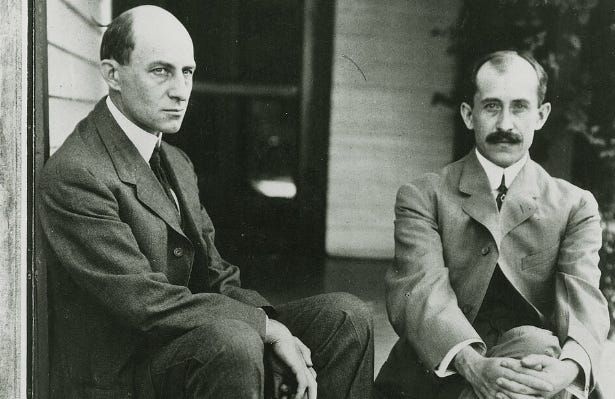
Like the tales of Genesis, this one begins with two brothers. They were inseparable from early youth, tinkering, insatiably curious about the world. Their father was a bishop. They were weaned not just on the Bible and theological works, but also on the classics. In their home, where everyone “read all the time”:
There could be found the works of Dickens, Washington Irving, Hawthorne, Mark Twain, a complete set of the works of Sir Walter Scott, the poems of Virgil, Plutarch’s Lives, Milton’s Paradise Lost, Boswell’s Life of Johnson, Gibbon’s Decline and Fall of the Roman Empire, and Thucydides. There were books on natural history, American history, a six-volume history of France, travel, The Instructive Speller, Darwin’s On the Origin of Species, plus two full sets of encyclopedias.
What did they make of Paradise Lost, with Satan labouring across Chaos on sail-broad vans, and Raphael sailing between worlds?
It was amongst these books they first read about the science and motion of birds and animals. In the late summer of 1896 Orville lay delirious with typhoid, close to death, and Wilbur kept vigil at his bed, reading aloud. Among what he read was news from Germany: Otto Lilienthal, the great glider man, had fallen from the sky and was dead. The news awoke an interest that had lain dormant since boyhood.
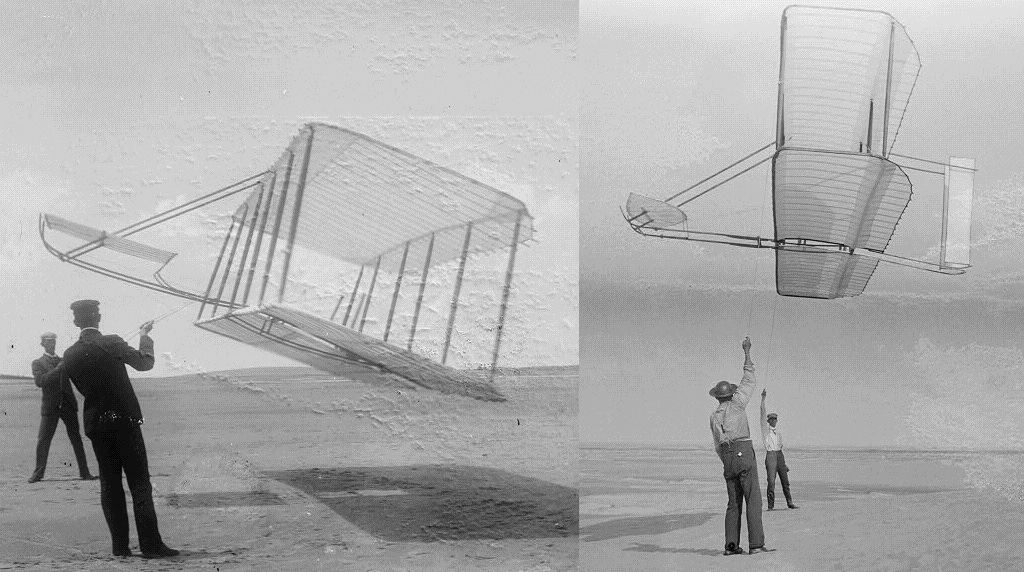
Eventually, to devote themselves properly to their work, they travelled to Kitty Hawk, a desolate sandbank off the coastline of North Carolina. A land of wind and sand. With no roads or bridges, it was only reached by boat. A fisherman’s outpost. The men of Kitty Hawk were “a hardy race, chiefly descendants of shipwrecked sailors whom storm and misfortune had cast upon the shores”.
The brothers fell in love with the gusts and hurricanes and sunsets and birds. They would stand for hours on the banks of the sea and stare upon Creation.
[T]he scene from the tent door—the scene from almost any point—was spectacular, with great stretches of water and sand dunes and beach and a tremendous sky overhead, with cumulus clouds rising like castles, thrilling to behold against the blue. Long flat horizons reached far in the distance in every direction. And then there was the wind, always the wind. It was not just that it blew nearly all the time, it was the same force that had sculpted the sand hills and great dunes of Kitty Hawk that shaped and kept shaping the whole surrounding landscape. Far from home, on their own in a way they had never been, the brothers seemed to sense as they never had the adventure of life. Orville would later say that even with all the adversities they had to face, it was the happiest time they had ever known. Birds on the wing, birds of every kind by the hundreds, filled the air— eagles, snow-white gannets, hawks, pigeons, turkey vultures, or buzzards as they were known on the Outer Banks, with wing spans of as much as six feet. Wilbur devoted hours to studying their movements in the wind, filling pages of his notebook, sometimes adding small drawings. The reality of what birds could do—the miracle of birds—remained a subject of continuing importance and fascination, and birdlife on the Outer Banks was beyond anything they had ever imagined…
The locals thought they were mad. Standing on the shore, the brothers would imitate the birds they studied. They’d bend their elbows and wrists to mimic the gannet or the hawk. Like Moses on the banks of the Nile, raising his arms and turning the river to blood, they possessed no magic. But the universe did, and it whispered its secrets to them.
The brothers wrestle with each challenge that arises. They suffer the wrath of the world. The deluge of a hurricane. Air thick with mosquitoes. They persist. They leave the land of their father, and dig wells in their new land, as did Abraham. They are scorned and mocked in the way of prophets. They persist.
Four years of wrestling with this frontier, of failing, of suffering. Then they fly. To strive, to seek, to find, and not to yield. What is this? What happened here? Who are these men who grasped at the wind?
They came to these strange beautiful lands to commune with Creation and to receive their revelation. Their revelation did not come written upon tablets, delivered from a thunderous mountain. It came in fits and starts, in unshakable faith. Pursued with calculated tenacity, each new step a fresh challenge to be resolved.
At one point they wanted to understand the propeller. They assumed they could rely on the theory behind propellers on boats, which had been in use for over a hundred years. But no such theory existed. Man did not know how the propeller worked. Practice had come before theory. “Our minds became so obsessed with it that we could do little other work,” wrote Orville. Their discussions on the propeller “became as intense as they had ever been. Heated words flew, filling hours of their days and nights, often at the tops of their voices,” writes McCullough.
Neither brother married or had children. They would not work on the Sabbath. In France, the French couldn’t understand why they weren’t enjoying their women and champagne, so focused were they on their work (and games in the park). Wilbur loved the sound of the Bollée bells and was smitten by the Cathédrale Saint-Julien, whose arches rose some 108 feet above the cathedral floor. He did not understand the Sunday service he attended, but he made communion with the men who reached up to the sky — like him — with their work. The brothers were monks. Protestant ascetics.
Their miracle of flight was perceived as such. Kings and dignitaries came as pilgrims to see the brothers work their magic. President Taft called them prophets and the press referred to them as the foremost magicians of the wind. Thousands watched Wilbur circle the Statue of Liberty, then days later a million New Yorkers watched him fly twenty miles up the Hudson and back. A British battleship fired a salute.
A writer for Le Figaro called Wilbur a zealot and wrote:
He and his brother made the conquest of the sky their existence. They needed this ambition and profound, almost religious, faith in order to deliberately accept their exile to the country of the dunes…
Wilbur was an uncertain prophet as all true prophets are. Moses had a speech impediment. “Who am I?” Moses asked God, when tasked with taking on Pharaoh. Here is Wilbur, on the moment he and his brother found the crown of flight lying in the gutter:
Scarcely ten years ago, all hope of flying had almost been abandoned; even the most convinced had become doubtful, and I confess that, in 1901, I said to my brother Orville that men would not fly for fifty years. Two years later, we ourselves were making flights. This demonstration of my inability as a prophet gave me such a shock that I have ever since distrusted myself and have refrained from all prediction…
Following their invention, the brothers found themselves mired in endless litigation and disputes, as though hopping out of Exodus and into Leviticus. In the spring of 1912, exhausted by the patent wars, Wilbur took a fever. Typhoid again, the same pestilence that had afflicted his brother, at whose bed Wilbur read the story of the killed flying man sixteen years before. Wilbur dictated his will, composing by voice like the blind seer on his father’s shelf. He died at forty-five. His bishop father wrote in his diary: “A short life, full of consequences.”
The story of the Wright brothers and their discovery feels like it should be a Terrence Malick film. It is the story of Creation, of a triumphant American Protestantism, of something ineffable and inscrutable at the heart of man and the frontier. Something in the austerity of their manners and the steadfastness of their wills matches the gusts and sandy banks of Kitty Hawk. It is all one thing.
Today we live in an age of miracles. A genie in our pockets. We speak to our machines and they obey. The most valuable companies in history have emerged to explore the frontiers of space or to summon new gods from transmuted sand. Flying machines are so ubiquitous we complain about their paths. Yet we grumble and bicker with the same intensity. We are the Israelites, who upon witnessing God split the Red Sea and deliver them from slavery, bicker and complain and look back down upon the minutiae of their lives.
When God beat down poor Job, Job questions his treatment. God responds, boastful, from the whirlwind (Job 39:26–27):
“Doth the hawk fly by thy wisdom, and stretch her wings toward the south? Doth the eagle mount up at thy command…?”
Flight is God’s test of man’s limits. The Wright brothers stood inside the whirlwind for four years, watched the hawk, and answered the question God asked Job.
A favorite Wright brothers story. After Kitty Hawk, they returned to Ohio and rented a farmer’s field to practice. An interurban railway ran by, so lots of people saw them, and wondered why the local papers weren’t reporting it. The reason was that there had been many years of false claims of flight, and cynical reporters believed these reports were false, too. Eventually they did send reporters and the story got out. That seems to be why the big news took a while to spread.