

In the winter of 1905 Hilda Petrie stumbled over stones amidst the ruins of the ancient turquoise mines of Serabit el-Khadim in the Sinai desert. For eight hundred years Egyptian expeditions had sent workers there to hack blue-green stone from the rock. Her husband, the great Egyptologist Flinders Petrie, was leading the expedition. When she caught herself and looked down at the fallen stones that had tripped her, she noticed something scratched into them. Not hieroglyphs — she knew hieroglyphs. These were cruder. Simpler.
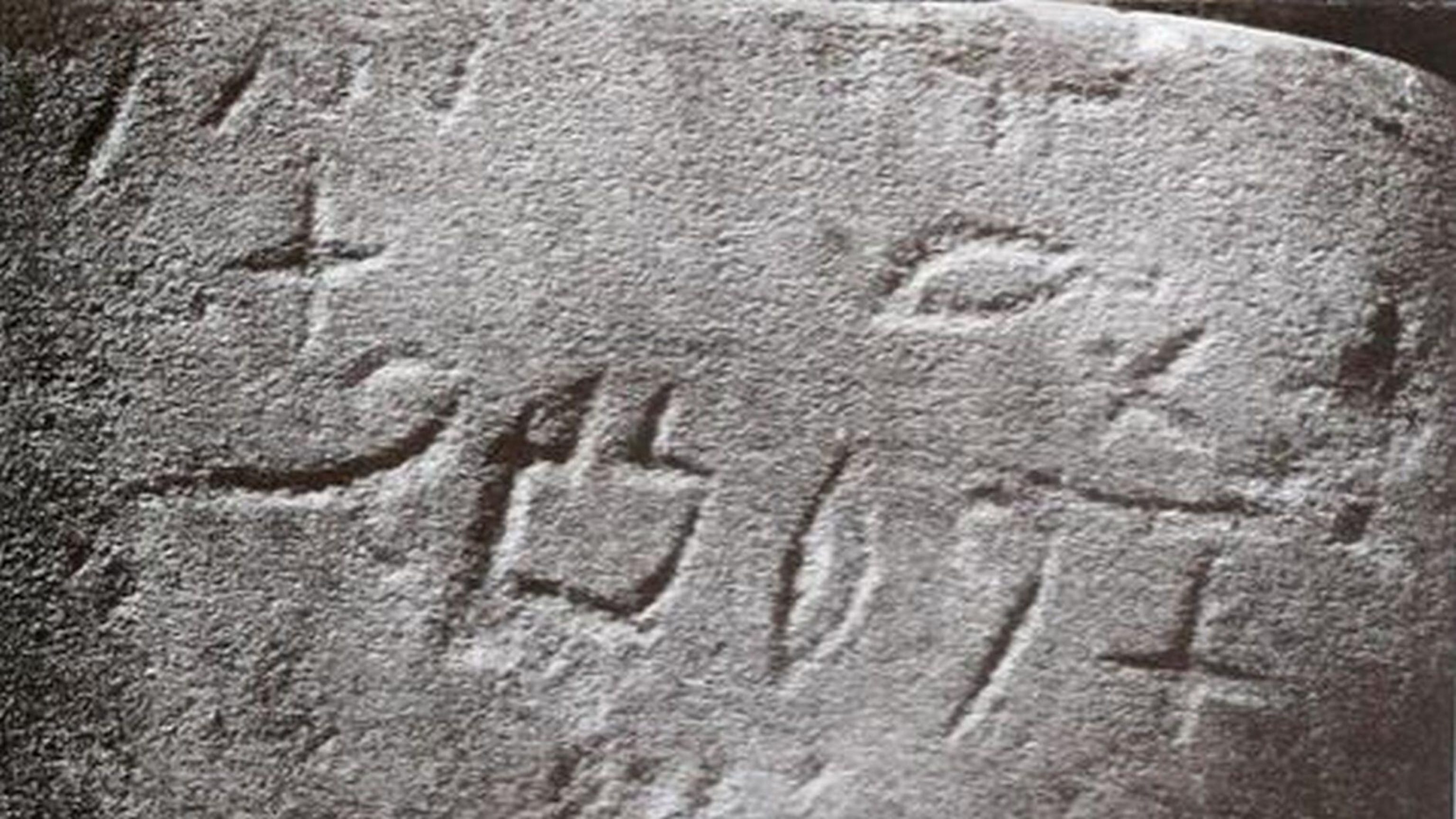
She was looking at one of the most important building blocks of human civilisation.
It would take a decade for anyone to understand what Hilda Petrie had found. In 1916, the British Egyptologist Alan Gardiner sat down with the inscriptions and noticed that one sequence of symbols kept repeating. If you assumed each symbol stood for a single consonant sound and if you assumed the sounds corresponded to the Semitic names for the objects the symbols depicted, then that repeating sequence spelled out a word: b-ʿ-l-t. Baalat. The Lady. A title for the goddess Hathor, who was worshipped at the temple beside the mines.
Gardiner had cracked it. These were not Egyptian writings at all. They were the work of Semitic-speaking people — foreigners in Egypt. It was an alphabet.
For over a thousand years before those scratches were carved, the great civilisations of the ancient world had writing. The Egyptians had hieroglyphs. The Mesopotamians had cuneiform. The Chinese had their ideograms. These systems were fantastically complicated. Egyptian hieroglyphics used over a thousand distinct symbols. Some represented sounds, some represented whole words, some modified the meaning of other symbols, and the rules for which was which were labyrinthine. To become literate in hieroglyphics required years of training. This meant that writing belonged to a tiny elite — the scribes, the priests, the palace bureaucrats. If you were a farmer, a soldier, a miner, a craftsman, you could not read. You lived and died in a world where the written word was locked behind a wall of expertise.
The alphabet destroyed that wall. With twenty-two symbols, you could write anything. Any word in your language, any name, any prayer, any contract, any story. A bright child could learn the system in weeks. And because the symbols represented sounds, not meanings, the system was portable — speakers of other languages could adapt it to their own tongues with minor modifications.
And the alphabet happened only once.
From those scratches on the rocks of Sinai came the Phoenician alphabet, and from the Phoenician came the Greek, and from the Greek came the Latin and the Cyrillic, and from the Aramaic branch came Hebrew and Arabic and the scripts of Persia and India and Tibet and Thailand and Mongolia. Every alphabet on earth.
Writing itself was invented several times independently — in Mesopotamia, in Egypt, in China, in Mesoamerica. Human beings, separated by oceans and millennia, converged on the idea of using symbols to record language. But the alphabet — the radical insight that you could represent all of human speech with a small set of symbols for individual sounds — that idea occurred to one group of people, in one place, at one time. Never before. Never again, independently. The concept was so profoundly non-obvious, so alien to every existing practice of writing, that in the entire history of our species, across every civilisation on every continent, it only came to one people at one time.
“Now therefore, if you will indeed obey My voice and keep My covenant, you shall be My treasured possession among all peoples, for all the earth is Mine; and you shall be to Me a kingdom of priests and a holy nation.”
— Exodus 19:5-6
And He gave to Moses, when He had finished speaking with him on Mount Sinai, two tablets of testimony, tablets of stone, written by the finger of God.
— Exodus 31:18
The infinite, unknowable God chose language as His medium — the one form of creation that is both bounded and boundless. A finite number of sounds. An infinite horizon of meaning. The God of Israel created an infinite universe from a finite act of speech. The human mind, made in that image, generates infinite thought from finite words. The alphabet gave humanity a grammar of creation. It made this shared architecture visible for the first time.
At Sinai the infinite God spoke to a finite people in finite words. Those words were written down in letters carved on stone. The archaeological record tells us that at this place — Sinai — among this people — Semitic labourers in Egypt — the alphabet emerged. The technology and the theology are mirrors of each other. It not only enabled the written Bible, it is the very shape of revelation.1
It took three millennia from the invention of the alphabet to the mass production of the written word with the printing press. Gutenberg's revolution was not in language itself but in its distribution. The alphabet had made writing possible for everyone; the press made reading available to everyone. Until then, the written word lived in the extraordinarily expensive scroll and codex collections of the very wealthy. Then, everywhere.
Today, for the first time since the printing press we are living through a revolution in the technology of language. Large language models take a finite set of elements, learn the patterns of their combination, and from those patterns generate new meaning without limit. The alphabet allowed humans to turn thoughts into symbols. AI devoured our symbols and is now turning them back into thoughts.
When God breathed life into Adam, the Targum says he became a ruach memallela — a speaking being. Language was the mark of the divine image in humanity. If a machine can now wield language too, what remains of that image?
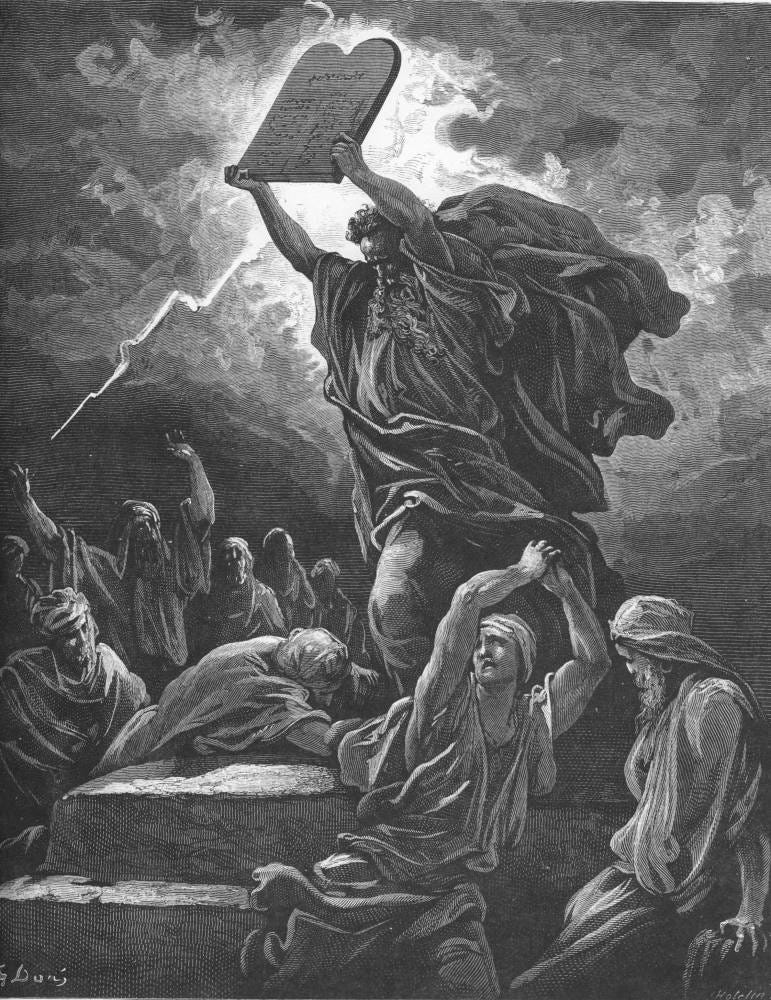
The late Rabbi Jonathan Sacks has written beautifully about the special role of the word in Jewish theology and culture.
Ahem. Korean.
Cheers for this. And for the link to Rabbi Sacks' astounding address.