

Joe Walker’s had a great run with his podcast. It is of tremendous value to Australian policy enjoyers and future historians who will wonder how Australia transformed so quickly and so radically in the last few decades, and with so little popular consent and understanding.
We’re also watching one man’s radicalisation in real time. Front row seats to the origin story of Dark Joe rising. Perhaps it began with his “red-pilling” (his words) by Peter Tulip who confessed last year that his supply-side focused policy on housing would do bugger all and take decades to impact house prices.
Immigration is sitting right there! Instant lever! Just pause it bro! But Tulip wouldn’t touch it. Besides, for politicians, when 66% of Australian households are home owners, raising house prices is the point. That’s the political economy in which we live.
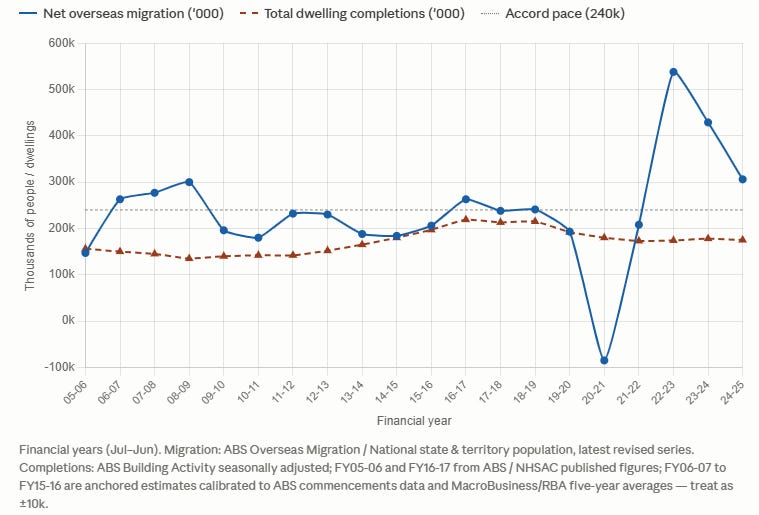
There is a whole public discourse taking place right now around building more houses and tinkering with tax incentives, when we are importing over 2 migrants for every new dwelling built. In the last three years we poured the equivalent of the city of Adelaide into this country. That’s why One Nation is #1 in the polls. Neuter right wing politics with this one weird trick.
So now we get Joe’s series on immigration.
First there’s Martin Parkinson, who ran the Australian Treasury (2011-2014), then the Department of Prime Minister & Cabinet (2015-2019). He was also the “chair of the Australian government's 2023 Migration Review (the most significant review of our migration system in more than three decades).”
Parkinson is also the Chancellor of Macquarie University, which probably should have been disclosed given some of the subject matter, and where he is clearly being self-serving.
Great questions by Joe. He has this lovely cuddly centrist schtick where these people will confess anything to him. I really appreciated the candour. Not quite as shocking as Abul Rizvi’s, but remarkable still. Some confessions in this interview:
We have a foreign working underclass in Australia that we accidentally stumbled into and wouldn’t have voted for.1
Migrant workers are undercutting wages and dampening investment in productivity enhancing technology.2
Foreign students are driving up rents.3
Even the whole concept of a skills shortage, which large parts of Australia’s migration policy are ostensibly there to fill, is basically fake — wages are the natural corrective mechanism, which are being suppressed.4
We import migrants for specific skills then bar them from working in those specific areas.5
Astonishingly — as a university Chancellor — he even confesses that international students negatively impact education quality at universities.6 I hadn’t realised that fact — no secret for two decades at least — had penetrated accepted institutional wisdom. Things must be really grim on the ground.

One feels for the poor Swedish backpackers, looking to find a handsome Aussie boyfriend, forced to go pick fruit on a farm.7 The reason you don’t have a beautiful Swedish girlfriend, anon, is that the agri and tourism lobbies are hoarding them via indentured servitude regional agricultural work.
Parkinson was occasionally a little cute, for example claiming international students don’t increase rents in places Australians typically want to live.8
Maybe his students don’t live in places where people want to live with endless space up in Sydney’s suburban North Shore, but the students at USyd, UNSW, UMelb, Adelaide, and others are central and surrounded by some of the most desirable real estate in the country.
He notes that international students cross-subsidise Australian university research. That may be true, but there are other potential sources of funding. They need not obviously be coupled. Maybe if the government stopped pouring $50bn a year into witch doctors, sex work (ok, they did stop that), and suburbs of hucksters, via the NDIS, they’d have more for R&D. Of course, just try clawing back that $50bn from your constituents. But that’s the political economy in which we live.
Never stops being shocking how the Australian business and technocratic class reduces women to their value as workers. Motherhood is a distraction from working. Gotta pump those labour participation stats. Have to hand it to Parkinson for conceding our immigration policy is in lieu of the kind of “long-term thinking” that supporting fertility rates might entail.9
One of my favourite bits: we hate these clunky Soviet-style bureaucracies, but love... unions / employer tripartite councils?10
Why aren’t we just auctioning off a fixed number of skilled places to the highest bidder? Because productivity is not the point. The point is filling the trough for unions and business interests. That’s the political economy in which we live.
The other two podcasts in the series are also essential listening. Mark Cully, a former chief economist at the Australian Department of Immigration (2009-2012), is shockingly clear-eyed, opinionated, and sceptical of decades of establishment wisdom around immigrants making us better off. He recognises university and employer interest groups as rent-seekers on the question of immigration. I’ve been banging on about the importance of Australia’s mass subsidised migration program from the 1830s for a while — glad to see him focus on it. I look forward to reading his book.
The conversation with Mike Pezzullo is interesting for other reasons. He ran the Australian Customs and Border Protection Service (2013-2014), then the Department of Immigration and Border Protection (2014-2017), then the Department of Home Affairs (2017-2023). Turns out we probably let in “tens of thousands” of migrants who we shouldn’t have prior to 2014.11 Whoops. Pezzullo is at pains throughout to emphasise that the immigrant terror threat is limited to a tiny portion of the Muslim migrant community. That may be so. But the question Joe doesn’t ask is: if one population brings in a few hundred men who seek to kill you (and a bunch more who non-violently hate you), and another population doesn’t, why not only bring the latter? Why bring any in at all? What exactly is the benefit we are getting as a country for this risk we are assuming? Pezzullo is pleased with the vast intelligence apparatus created to deal with the threat of a few hundred men. Understandably so, as he was charged with this noble task. But for over two centuries this was entirely unnecessary. Almost no one in our political class is bothering to ask whether we might absolve ourselves of this risk altogether.
WALKER: So we’ve kind of drifted into this almost guest-worker system. As you mentioned earlier, there are about, give or take, 2.3 million people here at the moment on temporary visas with work rights. Do you think if that system was put to the Australian public as a proposition, they would have voted for it or supported it politically?
PARKINSON: No, I don’t think they would have at all. And indeed, we say in the report that we’ve ended up with a sort of group of permanent temporaries, almost a quasi-guest worker system, without anybody consciously sitting down to decide that we should do this. And that if you asked the Australian public, as a review we thought it would be highly unlikely that they would have agreed to that.
typically unskilled migrants or lower-skilled migrants compete with Australian workers. So the increase in the size of the labour force means that there's not the same incentive to invest in capital-saving technologies. So you typically don't get the same boost to overall productivity, and typically what you do is get a bit of dampening in terms of the wage growth and the employment prospects for the existing population.
…[at] pretty much any of the car parks I go into, there is a hand wash operation there. It used to be that there were automated wash systems in multiple places. So maybe they’re providing a higher-quality service and people are choosing that. But equally, it may be a function of the fact that there’s a lot of relatively low-skilled labour available.
they are in an aggregate sense
WALKER: So I’ve got some questions about the permanent skilled program. The first one is, I was hoping you could help me understand how to think about skill shortages as an economic concept. It feels really slippery to me.
PARKINSON: It is.
WALKER: And one of the ways in which it feels slippery is I don’t understand how it’s not just another version of the lump of labour fallacy. Because if you’re bringing in more workers to address a skill shortage, they’re going to add demand to the economy, which is theoretically just going to shuffle the shortage around.
Of that quarter of a million with qualifications in skilled professions, 20,000 of those people we let in because they were teachers, 50,000 engineers, 16,000 nurses, 5,000 psychologists, and 1,300 electricians.
If you think about the skill shortages that we talk about, not all those people are going to go into those jobs even if they could. But we’ve made it really difficult for them to get into those professions, even though to let them into Australia we said, ”yep, you are able to come in because we think you’re commensurate with those professions”.
And yet what is the argument for capping international student numbers? I think there's a very legitimate argument if you wanted to make it around ensuring the quality of education for everybody who's at an Australian university.
And if you think about putting caps on, if you cap your working holidaymaker numbers below where they are, you're going to get screams from the industries where those people really make a contribution, so agriculture and tourism.
And yet what is the argument for capping international student numbers?… we’ve got the spurious argument that the rationale for doing this is because those students are driving up house prices. Well, you know the conditions in which students live. They’re not buying houses out in the areas that Australians want to live… They are typically congregated around where the universities are themselves. And this whole argument that they’re driving house prices is spurious.
WALKER: I guess you could say they are driving rents.
PARKINSON: Well, they are in an aggregate sense. But they’re not typically renting places that Australians might want to rent.
WALKER: So then that’s contributing maybe about, very roughly speaking, a half to two-thirds of population growth.
PARKINSON: Yeah. Because think about this the other way around. We had the Costello baby bonus. Historically, these sorts of things don’t lead to big effects. It did push up the number of births, but not a dramatically significant amount.
And if you’re looking for an economic impact, well, in the short term it takes more women out of the labour force. In the long term, when you get the benefit, you’ve got to wait for 20 years or so until those children have gone through the education system and are entering the employment market. So if you think you can fix this through fertility, you’re actually showing a willingness to engage in long-term thinking that I don’t see anybody willing to engage in on any other issue.
And we said, you’ve also created these tripartite councils through Jobs and Skills Australia where you’ve got JSA, you’ve got the unions, you’ve got the employers. Surely… they’re the ones who can tell you if this is a legitimate shortage or not. And so you can really get away from this clunky, rigid, old-style Soviet-style planning and to something that is able to deliver in response to changing occupations.
WALKER: So that implies that prior to 2014, we were letting in tens of thousands of people that we wouldn’t have wanted to. Is that the right order of magnitude?
PEZZULLO: I think that’s about the right order of magnitude… I did quite a lot of work on this in anticipation of one of the Senate estimates hearings, because there was a question about … particularly after the caliphate episode, whether we were checking deeply enough, thoroughly enough… I think we got the rejection rate up by at least a whole percentage point, if not 1.5 or something, which in absolute numbers was in the thousands.
Great article - you beat me to it!
Quite amazing to hear them admit most of the popular arguments for high immigration are nonsense, like the skills shortage argument, and the “solves ageing” argument (even if Parkinson says he buys the skills argument).
I always knew it wasn't my fault I didn't have a hot Swedish girlfriend -- now I have the proof to back it up. Thanks!