

Poetry makes nothing happen.
— W.H. Auden
SPOILERS
I sat mesmerised as I watched… what exactly? A new Dr Strangelove, with absurd parodies of twisted villains and idiotic systems? A Les Grossman spinoff? Were they really skewering Biden, the corpse president?
I was entertained, but with its unfolding structure of revelations and plague-on-both-your-houses aesthetic I didn’t really know what to think. This Substacker helped crystallise my thoughts.
Digger is a movie about the impotence of artists and their delusions of grandeur. It’s about art living in its own Potemkin universe, unaffecting the real world. It’s about creatures escaping their makers. Digger mocks its own form.
The movie unfolds in a kind of escalating impotence. You’re laughing at the buffoons on screen, then you’re jolted into the fact it’s put on. The main actor calls the whole performance cartoonish. Was I laughing at it? The movie’s not in on the joke. Is it making fun of me?
Then we learn that actually no, this catastrophe did happen and these people really were villainous. But what are we doing here? This is a play 20 years after the fact, a creature of the archvillain’s nephew. What’s the point?
Oh — the play delivers catharsis. It’s for the audience to clap like seals, decades after disaster, to unburden themselves upon their villain. It’s what happens every day on social media, in the news: we find a new main character, a new villain to drown in vitriol — necessarily a fiction, a creation of news and tweets and impressions. Yet we are not better for it. We are worse for it. Art gives the impression of action while actually giving catharsis and neutering us instead. In his final moments Digger Rockwell turns famine into feast, taking on the burdens of the world before plunging to his death. A Biblical scapegoat. Yes, he’s ridiculous and absurd, but show me a false prophet, a messiah, who wasn’t. And… it works! The catharsis delivers. We don’t understand these mechanisms. We don’t know why the form is the substance.
We need these villains. The revilement of Elon Musk, the stickers on Teslas distancing the owners from him. Why? Musk didn’t need to blow away a slice of Greenland into Europe. A few tweets, the wrong vibe, a little too much success, and ta-da: the perfect villain to deliver your very own catharsis.
Iñárritu villainises Digger but he is just as disgusted by Digger’s enemies. In this world American leaders may be bombastic and ridiculous, but the Eurocrats are a flaccid grey sludge. In the standout scene where the bureaucrats gather around hurling invective (and a shoe) at Digger while he tells them they need him — much like Jack Nicholson’s Colonel at Tom Cruise’s prosecutor in A Few Good Men — there are mannequins scattered amongst them. It’s a stage production. It’s all an act. The whole edifice is just a bit. But also: would a UN assembly or European Council really differ much if the participants were replaced by mannequins?
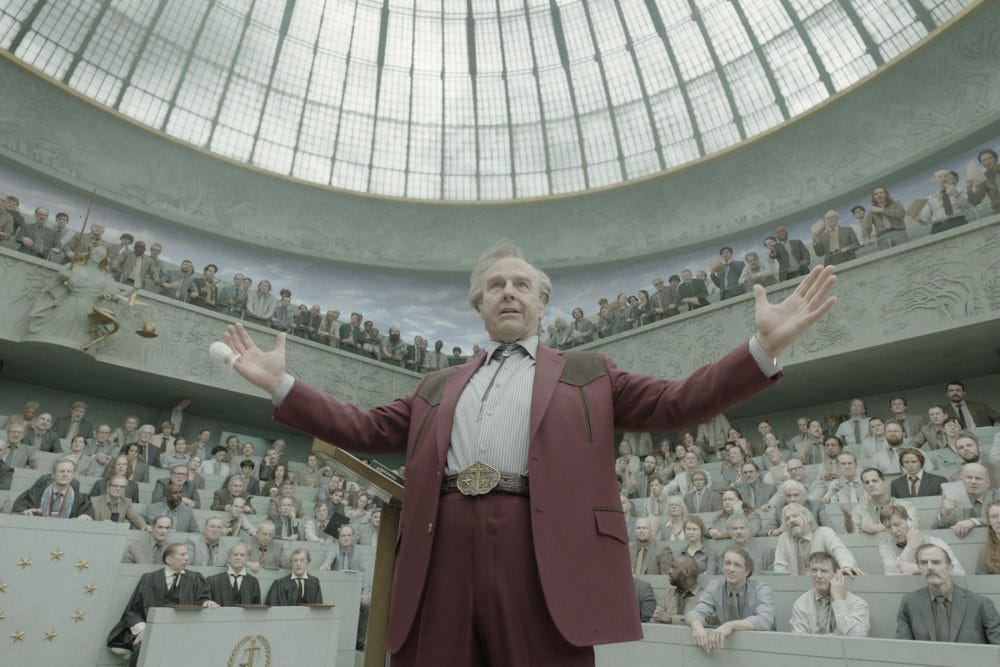
Iñárritu’s villains are destroyers of worlds, but their detractors are also repulsive. Stupid, ham-fisted hypocrites. Even when these critics have a point, it’s hard to side with them. Many such cases.
Artists are no exception. The self-righteous director and the actors live off the teat of the Rockwell family — the play is the creature of the real Digger’s nephew, who found it and funded it into a great hit. Here they are sticking it to The Guy, at the behest of The Guy, while being saved by The Guy: the heir even finds the protagonist’s lost daughter in the real world. Artists are worse than impotent. They’re the playthings of the men they profess to disdain. They aren’t just impotent, they’re lickspittles who barely bark at the hand that feeds them.
And the play escapes them anyway. The principal actor thinks the whole thing ridiculous and clownish to the point of revolting halfway through rehearsal. The director (a young black woman) blames all the white men in the cast — that entire generation — for the catastrophe that befell their world. But the play is beyond her. It’s the nephew’s own strange catharsis, a vanity project about his own family.
And not just in art. Consider the role The New York Times projects upon itself: an arbiter of truth, a paper of record, shining a public light on behalf of the huddled masses. Owned and controlled by a secretive multigenerational family, an heirloom passed down from father to son.
I recall reading Brecht in high school. I couldn’t quite articulate it, but even then there was something deeply off-putting about the whole pretense. Twenty years later, Digger has made something click about how I felt about a bunch of works — like Mother Courage — and how misplaced they were. Who were they talking to? What effect did they have on fascism or capitalism anywhere with their little plays? One might take them to task for abetting communism, but honestly, who cares? They didn’t impact communism either.
The Handmaid’s Tale was even worse. What strange sexual projection was this? How pretentious was its fragmentary writing style? Who was this person talking to? My fifteen-year-old self wasn’t having a bar of it. Incredible that an impotent work of art would decades later deliver a wardrobe to an impotent and performative activist movement.
In some ways Digger undersells the artist’s impotence and the strange cathartic role of political theatre. The play in Digger is impotent because it dramatises real events from decades ago while outside the world remains Fallen. But Henrik Ibsen’s A Doll’s House was taught to me in 2003 Australia about the condition of women over a century prior in Scandinavia. Teachers contort themselves to make it relevant today, but it’s impossible to read or enjoy A Doll’s House now except as an artefact of its moment. Yet we are supposed to draw some fighting lesson from it. The classroom was Digger’s theatre: an institutionally funded restaging of a decades-old controversy, performed for communal moral credit, pretending it still mattered. The cathartic pleasure we are meant to draw from A Doll’s House — that some seem to draw from it? — is way more tangential and absurd than the one portrayed in Digger.
(Thank you for letting me get a few 20-year-old gripes off my chest.)
Not only is art fake — so is food. There’s a scene where Digger offers Dr Ganesh tuna sashimi sourced from a 150-year-old family business in Japan where each fish is lovingly cared for. Our noble hero Ganesh, who avoids tuna for its overfishing, makes an exception. He relishes every moment of the slice of fish as though it were ambrosia itself. When Digger gets up, he tells Ganesh he has no idea where that tuna came from. It’s all fake. Providence is fake. Ethical sourcing is fake. Environmental activism is double fake: it’s performative and it’s misguided. Just like artists’ pretenses to truth-telling. Fake fake fake. A fugazzi.
You recall that exhausted cliché about art holding up the mirror to life. The movie plays it out in impotence. Not only are the artists impotent and everything they’re up to irrelevant — so are the politicians. They couldn’t stop the oil rig blowing up in Greenland. They couldn’t prevent the iceberg hitting the continent. They couldn’t repair their world. They’re ruled by a gerontocracy, subject to the whims of a Biden-esque corpse ruler, and the best we could do was laugh. We could laugh at this ridiculous undead ruler sitting on his throne, but so what? Joke’s on us. We’re the ones ruled by an undead ruler, unable to change anything about it.
Real-world impotence even pervades the mini-tragedy that unfolds offstage. The daughter of Tom Cruise’s actor gets lost. No one knows where her plane is after it takes off in a storm. Digger’s heir, the play’s patron, finds her. They thank him profusely for getting her home safe. But he didn’t get her home safe. “We just found it, that’s all.” He just found the plane and let them know she’s safe. It’s a deeply unsatisfying plotline where nothing really happens, no one really does anything — and yet it’s a happy ending. That’s a kind of managed decline, the kind of observer status we all have. We’re not doing anything. Our politicians are incompetent. Our art is pathetic and cartoonish, and even when it’s wielded in rage or for cathartic purposes, it’s just there: art for its own sake. Anything more is a lie we tell ourselves.
Digger ends up being this strange multi-layered cake where no one’s able to really do anything. The only thing anyone pulls off is the play itself. Once the play is done, in its luxurious no-expenses-barred way, they step out into a post-apocalyptic dystopia. Inside they’re LARPing revolutionary fire (like Richard Flanagan’s endless moral preening), but it’s 20 years too late, and outside there are robot overlords and “compliance is freedom” plastered across their dystopia. It doesn’t matter.
By the end we have lived and breathed this total irrelevance of the artist, and it’s brutal. Not only have we been totally sucked into this world (it’s so charismatic), but Tom Cruise is so effective and alive as this Digger Rockwell villain that once they step out into their dystopia and we step out of the film, we are belted by the puniness of the acting vocation. A poor player that struts and frets his hour upon the stage, and then is heard no more.
The Romans considered actors lower than prostitutes. This is a cry for help by Iñárritu. He has cast these people on the stage for us and he’s wondering: what the f*ck am I doing here? What are we all doing here? All I can do is make something charismatic. All I can do is flex what I have, my art. There is zero pretense to being able to affect anything.
If the artist can’t affect anything, he can still seduce. There is a genre of villain that dazzles, whom the audience finds delicious — villains who, through a mix of charisma and some irresistible truth hissing through their forked tongues, win the audience over. Ironically, these are often golems: creatures that subvert their creator’s will. Michael Douglas’s master of the universe in Wall Street. Zuck in The Social Network. Patrick Bateman in American Psycho. Tyler Durden in Fight Club. The entire Starship Troopers film is such a feat, insanely charismatic on its own terms in spite of its maker. (Total militarisation in the face of an alien threat is good actually.)
Did Iñárritu set out to create a monstrous villain who would nevertheless win over the audience? Did he intend for his creation to subvert his intention? Dr Ganesh, our bumbling hero, subverts his boss before the world by accusing him of every villainy he has witnessed him commit for decades. Prior to this they have this exchange:
Ganesh: “I won’t say what you want me to say.”
Digger: “How do you know? You might say exactly what I want you to say.”
In fact, Ganesh’s accusations are the layup to Digger’s speech to the Euro-eunuchs (“they pee sitting down”). Ganesh did say exactly what Digger wanted. Just like Iñárritu has you fall for a villainous buffoon by delivering him through the electric and irresistible Tom Cruise.
Art subverting the will of its creator is not an insult to the artist. It is the greatest compliment possible. It may be the defining feature of creation. When God made man, the first thing man did was disobey. So egregious became his conduct that He drowned Creation in the Flood and began again. In Digger the flood already came and nothing began again. No covenant, no rainbow. Just “compliance is freedom” on a concrete slab. The artist is a god without a flood. His creatures run amok and dazzle us with obscenity. And their maker can only clap with the rest of us.
The impact of art is power law distributed.
The most impactful art does create huge leverage in the world. But we’re made to pretend that all art is equally sacred.
It’s a bit of a motte and bailey trick that serves the art world well.