

WARNING: SPOILERS
The Handmaid’s Tale TV show ends transformed from where it began, accidentally (?) finding itself a champion of the most reactionary idea of all: a woman’s supreme gift and purpose in life is motherhood.
It still toys with some of its liberal fantasies (you have to fight for your rights or the fascists will come! Protesting is power!), but its heart’s not in it.
The show ends totally child obsessed, adopting the worldview it was created to mock.
In the final episode Janine's ultimate salvation arrives in the return of her child. She emerges from the den of all her horrific brutalisations — the gauging out of her eye, the beatings, the rapes, the sex slavery — to be redeemed in a reunion with her daughter. June only speaks about her daughter Hannah. And Serena — what has become of our villain queen, our overthrower of regimes, our poetess? All I ever wanted was you, she tells her infant son. It turns out she didn't actually want societal change. She didn't really want to overthrow a regime (twice). She just wanted a baby. And now that she is stripped of status and money and security and shelter — she has all she needs in her son.
The show began as a hyperbolic critique of conservatism in the form of Gilead, a violent fertility cult that takes power in response to climate-induced fertility collapse. As the show’s hero June escapes her ritualised rape and captivity, the show grasps for another motive to keep her in the fight. It finds a compelling one: her stolen daughter. It leans into motherhood as a wellspring of meaning for its characters. It moves away from its individualist female liberation roots and towards a conception of meaning and freedom that resonates typically with conservatives: the freedoms and meaning found in the constraints and duties and privileges of parenthood. Wasn’t the book born out of abortion-restriction anxiety?
The entire show is a projection of liberal fantasies and neuroses. Gilead is what you get when the climate wreaks havoc on the world. It’s what you get when you stop fighting for abortion rights. What do you get? White male protestant theocracy. Every good guy couple is mixed race or gay. Every villain is white, the princes and princesses of the realm immaculately dressed for every occasion. The show indulges the liberal urge to map oppression by skin-tone, granting automatic moral credits to the ‘diverse’ while reserving sin mainly for white men.
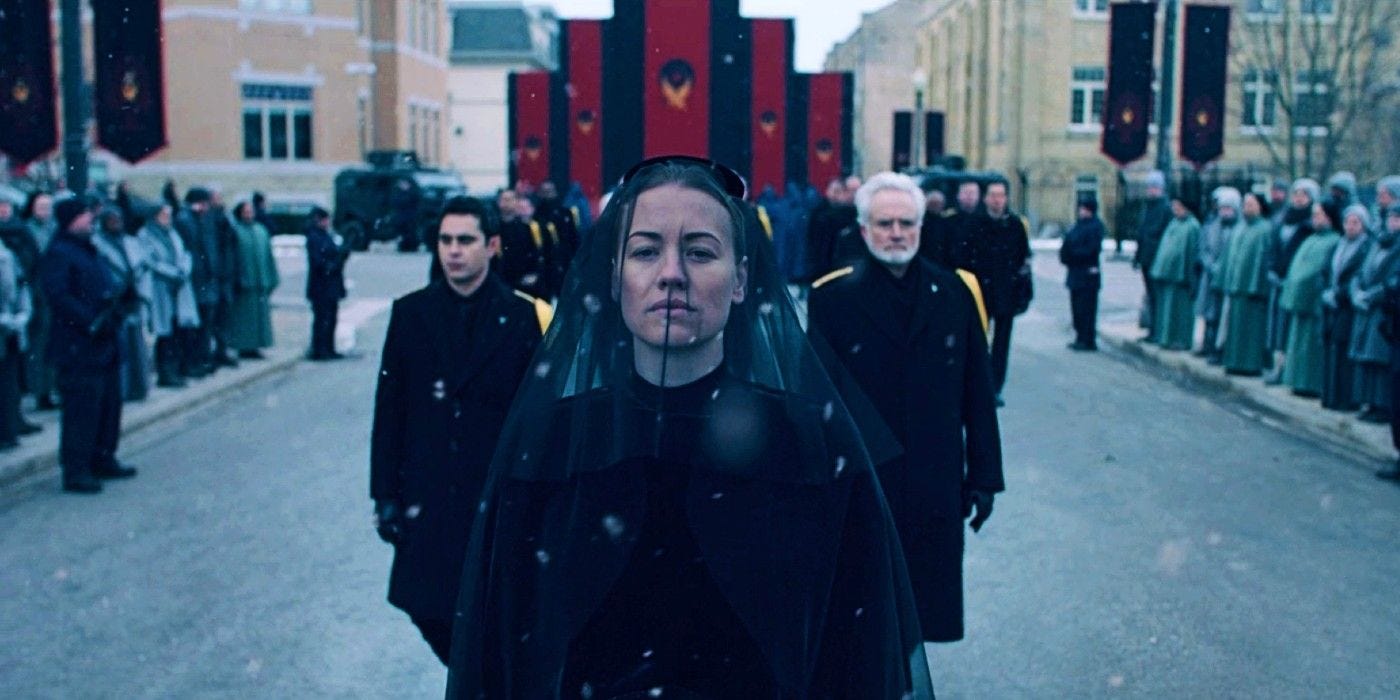
The shocking total aesthetic supremacy of Gilead is a strange psychological phenomenon. Elegant sharp lines and well dressed men terrorise the liberal spirit. Gilead’s uniforms, old timber homes, marble foyers, and razor-straight ranks give liberal viewers the creeps precisely because they’re beautiful (maybe it’s also a throwback to the whole Hugo Boss-outfitted-Gestapo thing). Immaculate coronations and funerals suggest fascism will arrive not in MAGA trucker caps but in high-fashion minimalism.
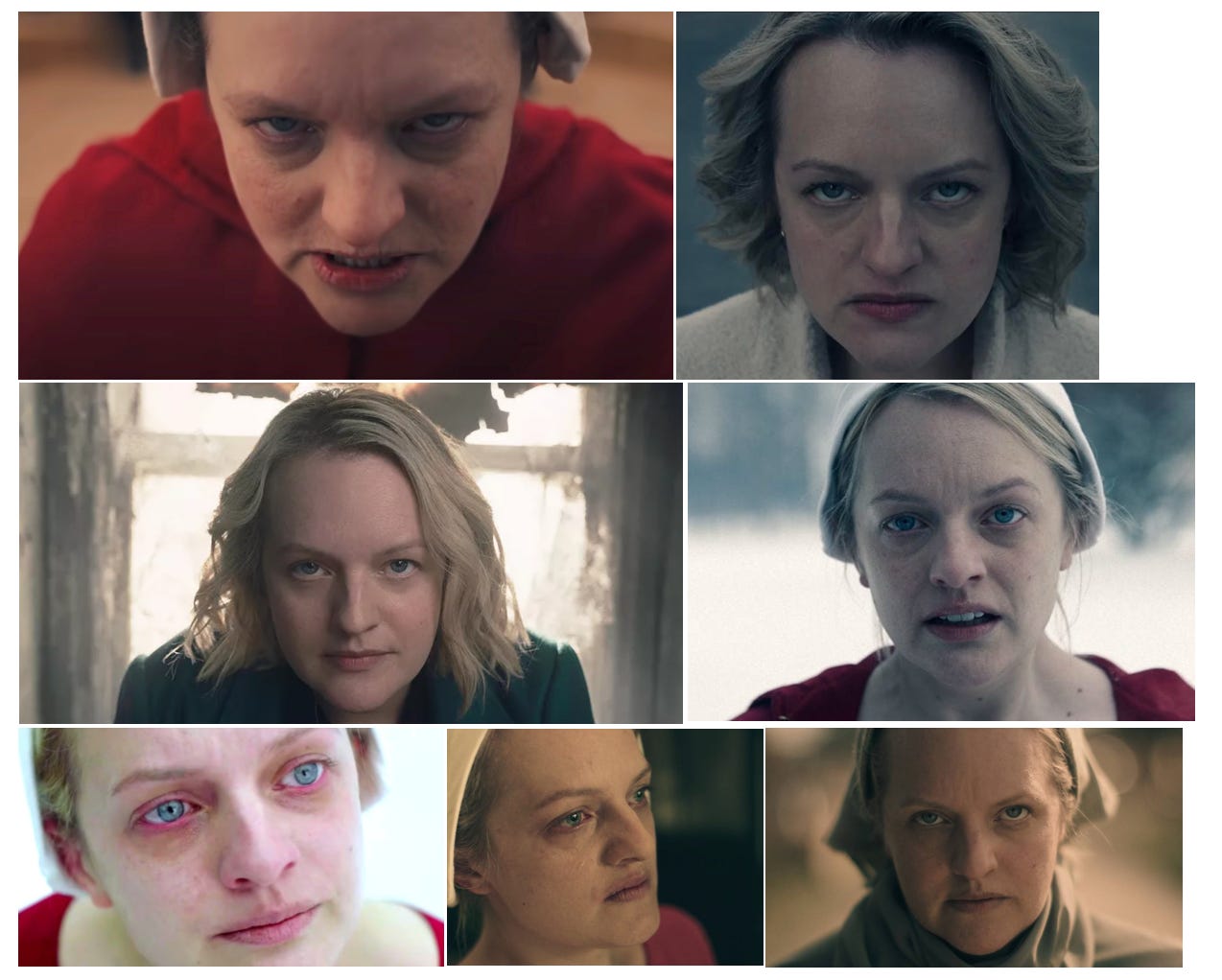
None of the prettier characters are the subject of true romance but our harrowing warrior-hero Elizabeth Moss, whose close-up horror visage is a staple of the show, is the object of endless romantic yearning. It’s the least believable part of the show, but it’s an awkward observation — like observing the latest romance fiction about the werewolf or bulked up pirate whisking about the innocent girl is ‘not believable’. It’s a trashy fantasy! Of course it’s not believable! That is what The Handmaid’s Tale eventually reduces itself to. Fantasy fodder. The most powerful men in the land are madly in love with this woman. Why not you?
Canada is a Pinterest-Board Utopia. Gilead is grim Boston; Canada is a coffee-shop refuge stocked with multicultural hugs and free healthcare. It’s the liberal fantasy of a border one train-ride away where every refugee gets an IKEA-furnished apartment and moral validation on arrival. (To be fair, the Canadians do ultimately turn on the American refugees.)
Men are emotionally helpless children. Even the ‘good’ men — Nick, Luke, Lawrence — are either mopey romantics or tortured collaborators longing to be told what morality looks like. It reassures a certain progressive instinct: if men would only cede the steering wheel, women’s moral clarity would sort out the mess.
When June finally lashes out — fingers in a Commander’s eyeballs, a group lynching in the woods — the show delivers vigilante justice free of legal or psychological blowback. It’s the liberal daydream of righteous rage: you can ‘punch Nazis’ (or gouge them) and remain the story’s uncontested moral center.
You can tell The Handmaid’s Tale was first released around 2017. It’s microwaved #Resistance porn. The show begins as a love letter to the Women’s March era. It flatters the viewer with the idea that tweeting, chanting in costumes, and brandishing Latin slogans constitutes an existential threat to authoritarianism. The regime trembles because plucky activists ‘speak truth.’ This is the world that in our post-2024 era has now been reduced to the frenetic echo chambers of BlueSky. The entire aesthetic is already dated and vaguely embarrassing in the same way of pussy hats and Kamala Harris (brat summer!).
But this was tough to sustain over 6 seasons, let alone through the demolition of the political vibe into which it was born. In its final landing, The Handmaid’s Tale’s original warning about patriarchy or theocracy petered out into something else: a confession. The soft spot in modern liberalism — its longing for the very order it pretends to fear, the meaning it denies but still craves. Mama wants her baby.
The problem right out the gate was that they couldn't make the bad guys evil just because. The writers were completely stuck between a Rousseau conception of human nature as inherently good, and a historical-materialist frame for all events. So they stuck on the "climate-induced fertility collapse" angle (despite being barely mentioned in the book) to justify Gilead, because you can't just have people be dicks because of humanity's fallen nature. But when you rationalize a bad guy, you end up making them sympathetic, and a show like this can't allow that to happen, so they ended up bringing back original sin but just basing it off sex and race.
So in a way from the start it was deeply conservative in that it concedes that the left-wing conception of human nature wasn't capable of accounting for atrocity.
BUT the real issue with the show was that it was BDSM porn for liberal women who have a submissive kink but can't just say so. Simple fact is, anyone who kept watching this show and the abuse it constantly threw at women must have liked it. I mean this seriously. All of the politics was just window dressing for girl porn. There is not a single woman who watched this show past season 2 that isn't into spanking FULL STOP.
Hmpffffff.
I watched an episode or two and had to admit that the story had potential… but then it fell into the predictable, dreary femcunt agitprop and woke BS.