

As promised in my 2025 roundup, my piece on New Zealand. The fruit of last summer’s fascination. I’m releasing it in six parts.
Part 1: Introduction
Part 3: Colonisation & Settlement
‘Tis not too late to seek a newer world.
Push off, and sitting well in order smite
The sounding furrows; for my purpose holds
To sail beyond the sunset, and the baths
Of all the western stars, until I die.
Though much is taken, much abides; and though
We are not now that strength which in old days
Moved earth and heaven, that which we are, we are,
One equal temper of heroic hearts,
Made weak by time and fate, but strong in will
To strive, to seek, to find, and not to yield.
— Ulysses by Alfred, Lord Tennyson
“Their tramping is to our hiking as marathons are to jogging.”
— Fairness and Freedom by David Hackett Fischer
“When you see a man who is exactly like an Englishman, but who abuses the English, you may know he is from New Zealand or Australia.”
— Edgar Watson Howe, 1913
“If I showed my true feelings I would cry; it’s the best country I have been in.”
— George Bernard Shaw, on New Zealand
Suppose you are the British Empire and you have already made one America.
It has gone poorly.
You sent settlers across an ocean. You gave them charters, governors, land, laws, and a theology of English liberty. They became rich, self-governing, litigious, armed, jealous, and eventually ungrateful. They decided that Englishmen had rights, that they were Englishmen, that Parliament was treating them as something less than Englishmen, and therefore that they would stop being Englishmen altogether. They revolted and built a new republic.
A few decades later, chastened and moralising, you try again at the edge of the world.
By this time, you have already founded a new colony in New South Wales. But it was founded as a dump for convict overflow. You want a respectable destination for respectable folk.
Rather than unstructured waves of fleeing and prickly Puritans, Cavaliers, Quakers, and border clans seeking respite, you send select families and missionaries — before the riff-raff whalers, escaped convicts, and grog-sellers make too much of a hash of it.
You do not send them to an empty land. You find a people who are in many ways a mirror of yours: a seafaring warrior people, a people who remember their own arrival to these lands. These Māori are numerous enough, armed enough, coherent enough, and proud enough that they cannot be ignored.
The result is New Zealand.
David Hackett Fischer’s Fairness and Freedom seeks to answer one question: why did two societies with British roots, settler frontiers, representative government, Protestant moral vocabularies, immigrant populations, and expansionist histories end up with such different moral centres? America’s sacred word is freedom. New Zealand’s is fairness. Americans, Fischer says, do not dream of equality; they dream of wealth. They do not want to get even; they want to get ahead. New Zealanders have much deeper communitarian instincts.
“Freedom” can explain the Declaration of Independence, gun rights, the First Amendment, westward settlement, venture capital, high inequality, religious pluralism, and why every American political faction believes it is oppressed by a different federal agency.
“Fairness” can explain early women’s suffrage, Māori seats in parliament, social democracy, land reform, rugby etiquette, and why New Zealanders have evolved a sixth sense for detecting someone getting above themselves.
Fischer’s binary is a useful entry point. But what emerges from his book — and from a broader reading of New Zealand history — is something stranger and deeper. The moral centres of these two nations were not so much chosen as seeded: by who came, by when they came, by the dispatch moment in British imperial history, and by the peoples they found waiting on the other side of the ocean. Selection effects all the way down.
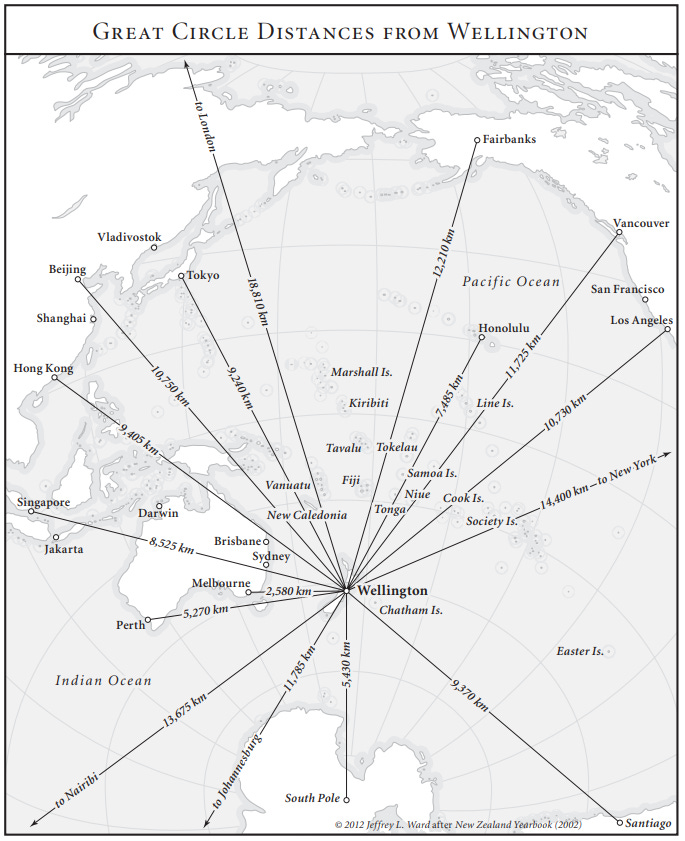
What’s missing from his analysis is Australia, which pulls like dark matter in his story. New Zealand is often treated as Australia’s little sibling, but that is mostly a trick of maps. It is larger than Great Britain and is “near” Australia only in the Pacific sense: Wellington and Canberra are roughly as far apart as London and Moscow. New Zealand was not an Australian appendix. It was a different settler experiment, run at a different imperial moment, against a different indigenous counterparty.
Your impression of New Zealand might be of a small, cuddly nation — a Hobbit town with a minority Polynesian population. You would not be exactly wrong. But it belies a far stranger history. A nation founded on deep Christian convictions, with an almost frenzied military ethos. A nation that was as far as possible from revolting against her mother country, one that clung to its mother country so tightly Britain had to pry Kiwi fingers off when she abandoned her. One that is still working out who it is in the aftermath.
The book itself
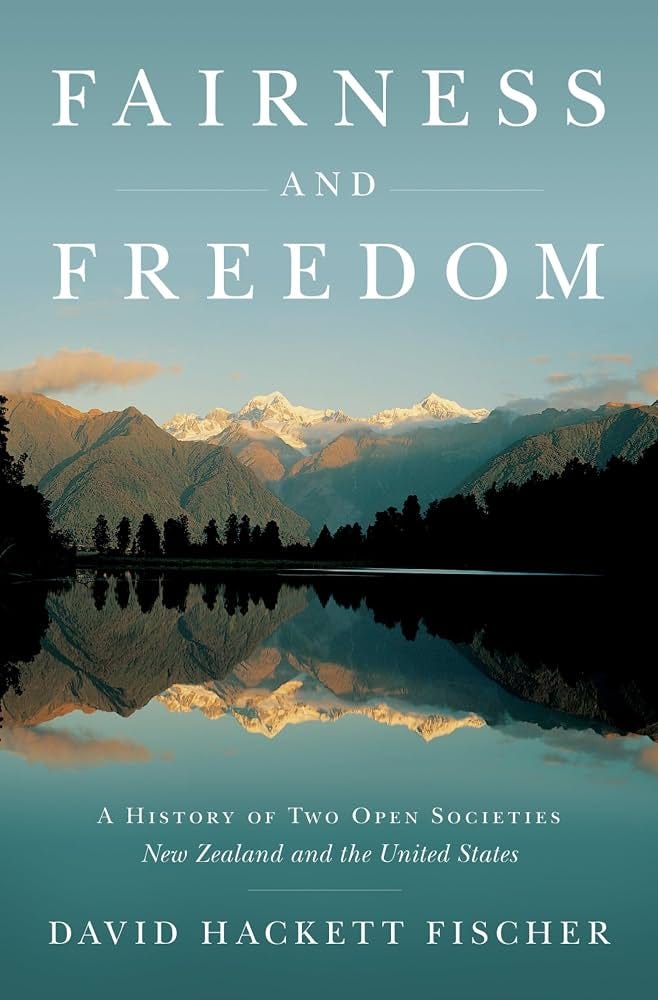
After Albion’s Seed, a 500-page anthropology by Fischer is self-recommending. This one is born of a personal affection from working and living in New Zealand. As happens when travelling, it cast his home country in a new light. When both are Anglo-settler colonies with martial native peoples, the comparisons stack quickly.
The book’s greatest weakness is in its subtitle premise: the framing of America and New Zealand as “open” as opposed to “closed” societies. It’s not that often deployed, and when it is it feels like a flattening. For example, Fischer credits the freeness of Western societies with their victories in the world wars. Apparently the soldiers of “open” societies were more flexible in the field and had higher levels of innovation leading to greater advances in weaponry. These arguments are not fleshed out in depth and are not convincing for reasons that go beyond the scope of this review. But they are aren’t essential to the book.
Fischer also spends some time upfront on the etymology and history of the ideas of freedom and fairness. The Puritans’ idea of freedom is gorgeous:
Other Puritans shared John Cotton’s idea of “well-ordered liberty,” which John Winthrop defined as the liberty to do “that only which is good.” Nathaniel Ward, author of the Laws and Liberties of Massachusetts, wrote that “all Familists, Antinomians, Anabaptists, and other Enthusiasts shall have free liberty to keep away from us.” Dissenters were banished on pain of death if they returned. Three Quakers who came back were hanged on Boston Common.
Did you know the term “maverick” comes from a family of American nonconformists? One Samuel Maverick irritated the Puritans in Massachusetts; a later Samuel Maverick in Texas refused to brand his cattle, giving his name to any animal that bore no man’s mark.
The etymologies of fairness and freedom are fun, but they aren’t the engine of the book. The comparison itself is what pops with surprise. Each country comes into focus when held against the other. Reflected in one another they reveal the contours of deep historical differences that led to fundamental differences in character. I add Australia as a third point of triangulation.
The land of birds
New Zealand’s strangeness precedes human settlement. It is the land of the birds.
Once upon a time giant reptiles dominated most continents, until their annihilation by meteorite. Then followed the age of mammals. New Zealand formed an entirely different island ecosystem deep within the Pacific Ocean. With no snakes or large mammals this island paradise generated bird species of endless size and variety. Birds who knew only a world without ambush.
What a paradise it must have been to its first human inhabitants, the Māori, who landed on its shores around the late 13th century. While Genghis Khan had recently left the largest contiguous land empire in history and King Edward I (Longshanks) quelled rebellions in his domain, the Māori set foot on a vast land populated by flightless birds with no defensive instinct against them or the dogs and rats they brought. Many were wiped out. (More bird species died out after the Europeans arrived. In one case, perhaps fanciful, a single lighthouse keeper’s cat wiped out an island’s entire species of bird.)
Who are New Zealanders?
Selection effects define settler societies. This is vastly underappreciated.
Who comes, where do they come from, and what are the circumstances of their departure and arrival? These questions define the make-up of new societies and the folkways they seed. Are these settlers a general sample of their communities, or do they over-manifest any virtue or vice? Are they a nation’s intellectual cream, fleeing persecution? Or perhaps its criminal dregs, dumped far away to be made someone else’s problem?
The US selected for persecuted peoples forced to make their way through hostile territories and forge an independence, and then for those seeking a better future in a great land of opportunity. These people mainly paid their own way. They cut their life from the earth themselves, rejecting the despotism they fled. Hence America’s love of freedom.
Australia selected initially for convicts and their gaolers, but then for around a century-and-a-half subsidised British settlers with paid passage and land. Subsidised migrants prefer subsidies — one reason for the antipodean trust in the state and its provisions. Influxes of gold prospectors made their mark too, infusing the land with risk-seeking men.
New Zealand was no dumping ground for prisoners, although it was a haven for whalers and scofflaws prior to British colonisation. Its initial settler waves were strictly selected for upright British Christian families. It too subsidised migration to its shores ever since, and attracted its share of gold prospectors. These broad selection effects, coupled with the specific missions which founded it, have shaped its national character.
Just like in Australia, after about a century of largely British immigration, and after the post-WWII collapse of the British Empire and Britain’s turn towards Europe in the 1970s, New Zealand opened its doors to a wider range of European and Asian immigration, and its face has dramatically changed over the last few decades.
The other selection effect isn’t who came, but when. The Britain that settled the US in the 1600s was not the Britain that settled New South Wales in 1788, which was not the Britain that settled New Zealand after 1840.
The Britain of the 1600s was grappling with the Reformation, questions of tyranny and monarchical versus parliamentary power. The American revolution and the pertinent questions at her founding were about freedom.
By 1788, Britain was more liberal, fermenting in the Enlightenment. By 1840 it was deep into its liberal progressive arc, having abolished slavery and passed the Reform Act of 1832. So South Australia (settled in 1836) and New Zealand (1840) have more in common than South Australia and her eastern Australian counterparts. South Australia and New Zealand were settled by free men and women, with broadly equal gender ratios. They were settled by corporate missions and with educated populaces. It’s no coincidence that South Australia and New Zealand were the earliest grantors of the franchise to women and innovators in electioneering (South Australia pioneered the secret ballot).
This contrasts with the Australia’s eastern states, which were first populated mainly by men — convicts and their captors, then prospectors amidst the gold rush. Australian colonies’ highest GDP per capita in the world in the 1880s was flattered by the skewed gender ratio: disproportionate numbers of male prospectors and agricultural labourers meant fewer dependents in the mix and far higher labour participation.
But the question of who New Zealanders are cannot be answered without a deeper dive into its first inhabitants.
There are entire sections of this essay which more eloquently express an argument that I’ve made many times about how colonial cultures are formed and how SA and NZ feel very familiar - so naturally I completely agree with this and it’s obviously correct, no notes
Excellent, but New Zealand only reached gender ratio parity on the eve of world war one, so I'm surprised that you consider it broadly at parity in its early years.
When I looked at one of my ancestors who had thirteen children half the boys never married.