

Not only did we once build new cities, but there were men amongst us who dared to build new nations.
In the wake of the great shearers’ strike of 1891 — after the defeat and arrests, and the mounted infantry dispersed the camps — William Lane decided there was no hope for workers in Australia. He would build a new society somewhere else. A white, socialist utopia. Nueva Australia — a New Australia in Paraguay.
To understand what drove two hundred and twenty Australians to board a ship for a jungle on the other side of the world, we must first understand what happened at Barcaldine.
By January 1891, the Queensland outback was as close to civil war as colonial Australia ever came. The pastoralists — the squatters, men who owned country the size of small European nations — had announced wage cuts and demanded shearers sign individual contracts that would break the unions. The shearers refused. Strike camps sprang up across central Queensland: at Clermont, at Hughenden, at Barcaldine, where up to a thousand men camped in tents arrayed in military rows along the south bank of Lagoon Creek. Many were armed. The Brisbane Courier asked whether “the industrial Armageddon” was about to be “fought in the heart of Australia.”
The colonial government’s response was overwhelming. More than two thousand soldiers and police deployed to the wool districts. Artillery pieces and mounted infantry took up positions near the strikers’ camps. In late March, police swept through the camps and arrested the strike leadership. Thirteen union leaders were convicted of sedition and conspiracy at Rockhampton and sentenced to three years’ hard labour on St Helena Island prison, in Moreton Bay. By May, the camps were full of hungry, penniless men. The strike was broken. The squatters had won.
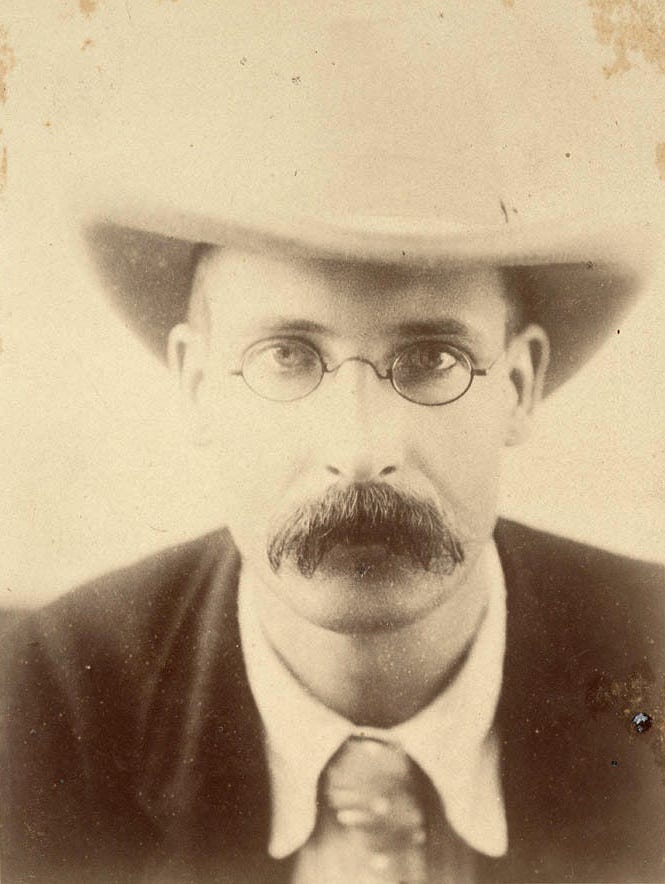
Lane had watched all of this from Brisbane, where he edited The Worker, the union-funded newspaper that had become the voice of the movement. He was thirty years old, an English immigrant who had come to journalism through poverty and odd jobs across three continents — Bristol to Canada to Detroit to Brisbane. He was small and intense, an orator with what contemporaries called an American twang, a teetotaller so committed that he had once got himself deliberately arrested as a drunk to expose the conditions in Brisbane’s lock-ups. He wrote under a dozen pseudonyms. His novel, The Workingman’s Paradise, published under the name John Miller, sold copies to raise funds for the families of the imprisoned strike leaders.
The defeat of 1891 convinced Lane that reform within Australia was impossible. The capitalists controlled the state; the state would always crush the workers. The only solution was to leave — to create, somewhere else entirely, a society built from first principles. He announced the formation of the New Australia Co-operative Settlement Association. Each male member was required to contribute a minimum of sixty pounds — equivalent to perhaps eight thousand dollars today — representing the sale of their homes, their savings, everything they had. In return, they would receive a share in a new civilisation.
The rules Lane drafted for this civilisation were uncompromising. “It is right living to share equally because selfishness is wrong,” he wrote. “To teetotal because liquor drinking is wrong; to uphold life-marriage and keep white because looseness of living is wrong.” No alcohol. No fraternising with non-whites. No private property. The colony would be “genuinely democratic and co-operating,” with “all labour in common for the common good.” It would be the brotherhood of English-speaking whites.
Paraguay had reasons of its own to welcome these dreamers. A generation earlier, the country had launched itself into a war against the combined forces of Brazil, Argentina, and Uruguay — the War of the Triple Alliance, which lasted from 1864 to 1870 and became the bloodiest conflict in the history of Latin America. When the Paraguayan dictator Francisco Solano López was finally killed by Brazilian troops in 1870, his country was devastated. The war had killed somewhere between half and two-thirds of the total population. By some estimates, 90% of males of military age had perished. A postwar census found 221,079 people remaining: 106,254 women, 86,079 children, and 28,746 men. Four women for every man. The government was desperate for settlers — anyone who would come, who would work the land, who would repopulate the emptied countryside.
Lane’s scouts negotiated a grant of nearly half a million acres of fertile country, free of cost and without taxes, in the interior south-east of Asunción.
On 16 July 1893, two hundred and twenty Australians boarded the Royal Tar at Mort Bay in Sydney. The ship had been built for cargo, not passengers, and had to be extensively modified to accommodate the emigrants. The manifest recorded men, women, and children from across the eastern colonies — Queensland bushmen and shearers predominated, but there were also urban workers, idealists, and at least one suspected police informant. Among them was Hugh Blackwell, one of the strike leaders who had been arrested at Barcaldine, looking for a fresh start after his release from prison. There was George Birks, an Adelaide chemist who had sold his shop on Rundle Street to contribute to the common fund. There were families—the Hoares from South Australia with their children, the Kempsons with four young ones, the Thomas family with six. Men who had lost the strike and lost hope. Women who had watched their husbands come home defeated.
A farewell gathering was held at the Sydney Domain. The chair was taken by Chris Watson, a young union organiser who would, eleven years later, become Prime Minister of Australia — the first Labor prime minister anywhere in the world. Watson spoke of the workingman’s paradise to be established in the hinterland of tropical America. William Holman, who would himself become Premier of New South Wales, also addressed the crowd.
The voyage took sixty-eight days. They sailed south, rounding New Zealand, then fought through the storms of Cape Horn — the most dangerous passage in the world — before turning north up the Atlantic coast of South America to Montevideo. There they transferred to a riverboat and began the long journey inland, up the Río de la Plata, up the Paraná, up the Paraguay, a thousand miles into the heart of the continent. They arrived at Asunción on 22 September 1893. From there, a train took them to Villarrica, and then bullock carts carried them the final distance to the site of the colony, where the countryside looked, some of them said, like the Darling Downs back home.
But the Darling Downs it was not. The land was rough, uncleared. They had no common language with the Guaraní-speaking locals. Many of the colonists, it turned out, were urban idealists or what some called misfits and malcontents — men who had never cleared land in their lives. John Alfred Rogers wrote home: “there are several people here barefooted and without a shirt to their back and very often an empty belly.”
Lane’s rules were strict, and he enforced them with the zeal of a prophet. The ban on alcohol was tested quickly. On Christmas Day 1893, several men visited a nearby Guaraní village, obtained liquor, and returned to the settlement drunk and fighting. Lane called in the Paraguayan police and expelled them. A visiting British diplomat assessed Lane as “remarkably deficient in the tact and human sympathy so necessary in a leader of men.”
Tensions arose too about labour and women. Some colonists, men who had paid their sixty pounds and crossed an ocean, began to suggest that if this was to be a workers’ paradise, they might hire cheap local labour — the very kind of exploitation they had supposedly left behind. Others began to fraternise with Guaraní women, which Lane treated as the ultimate betrayal of the colour line.
A second boatload of emigrants arrived from Adelaide in early 1894. The factional fighting intensified. By May 1894, less than eight months after the founding, Lane had had enough. He and fifty-eight loyalists split off to form a second settlement called Cosme, seventy-two kilometres further south, on the banks of the Pirapó River. The remaining two hundred and seventeen colonists at New Australia abandoned socialism, asked the Paraguayan government to dissolve the cooperative, and divided the land into private holdings. Some drifted away — back to Australia, or to sheep stations in Patagonia, or into the Paraguayan interior.
Mary Gilmore, who would later adorn the ten dollar note, reached Cosme in January 1896. After helping the movement from Australia, she resigned from teaching in late 1895 and sailed to Paraguay to join Lane’s experiment.
Lane held on at Cosme for five more years, watching his second utopia fail more slowly than the first. Crops failed and colonists starved. His own health broke down. In 1899, exhausted and disillusioned, he resigned the chairmanship and sailed away with his family, first back to Australia, then to New Zealand. In Auckland, he reinvented himself as a conservative. He became editor of the New Zealand Herald, the establishment paper, and wrote under the pseudonym “Tohunga” — the Māori word for prophet. The radical socialist of the 1890s became an Empire loyalist, an ardent conscriptionist during the Great War. When he died in 1917, aged fifty-six, of bronchitis and a heart condition, the Australian labour press was divided between those who remembered what he had once been and those who could not forgive what he had become.
Lane never spoke of Paraguay again.
But something survived. Two thousand people in Paraguay still carry surnames like Wood, McLeod, Murray, and Kempson. They are cattle ranchers now, not communists. Some have become quite wealthy landowners, employing the very kind of labour their great-grandparents once refused to hire. They speak Spanish and Guaraní.
This was actually quite a common thing in South America. There was also an attempt to create a Welsh colony in Argentina and a Croatian colony in Chile
"The Bulletin wishes Lane, and all who have gone and are going, the most complete success. It has not hesitated to say straight out, in the most sufficient words, that it thinks the scheme unpromising to the verge of insanity. For doing this it has, of course, been regarded as an enemy by the pioneers, or deserters. But it will wait the verdict of this ripe experience, and rejoice with them if its warnings prove to be misplaced."
22 July 1893