

WARNING: SPOILERS
There are very few examples of good marriage on TV or in film. Plumbing the depths of marital dysfunction is a rich vein of creation. A Faustian pact binds Tony and Carmela’s marriage in the The Sopranos, where every marriage is fatally compromised except that of Johnny Sack and Gini, who are more a punchline than a fleshed-out marriage (excuse the pun). In Breaking Bad, marriage is a vice grip that Walt escapes then hijacks. Hank and Marie’s marriage is close to platonic but it is infertile and dies with him. Mad Men is in love with the aesthetic of philandering and the archetype of the boredom-broiled housewife. Fleishman is in Trouble peers into the horrorshow of divorce.
But for Elizabeth and Philip Jennings, the All-American undercover Soviet spy couple of The Americans, marriage turns out to be the bedrock of all things. Their marriage is born a fraud, a cover, arranged from above. It is under constant pressure. They spend days, nights, weeks apart. They even hit ‘pause’ on their marriage, Philip moving out to a grimy motel. Part of their job is to sleep with informants. Philip even marries an FBI secretary in a sham marriage, which Elizabeth attends as his fake sister. Elizabeth falls in love with a black communist collaborator, going to him when pregnant with Philip’s child. They have deep ideological disagreements — Philip eventually quits their spy practice. And yet, in the end, their marriage is all that’s left. As their cover unravels and the world they knew for decades collapses, they are forced to abandon their son. Their daughter abandons them. They are left with absolutely nothing but each other. Their world burns to a cinder, leaving only their covenant at its core. The earth breaks upon their marriage.
The Jennings’ marriage begins not with love but with duty. It thrives because it’s explicitly an unchosen obligation, and it is our unchosen obligations that define us. Their marriage is assigned by the Soviet state, a bureaucratic arrangement between two agents who barely know each other. Modern culture assumes marriage begins with love and only later discovers obligation. The Jennings’ marriage runs in the opposite direction. Obligation comes first — loyalty to the mission, loyalty to the partner — and love slowly grows out of it. What begins as a fraud becomes a covenant. It’s a fantastic irony. The Soviet state accidentally creates a stronger marriage than does modern Western society. The system that produces sham identities and lies ends up producing a real covenant while the free, romantic American marriages around them are mostly fragile.
Life as a spy mirrors that of a marriage. A lifetime commitment. An imperceptible future beyond an idealistic initiation. Only the vaguest, theoretical conception of the challenges that lie ahead. A constant performance — for others, for your children, for each other.
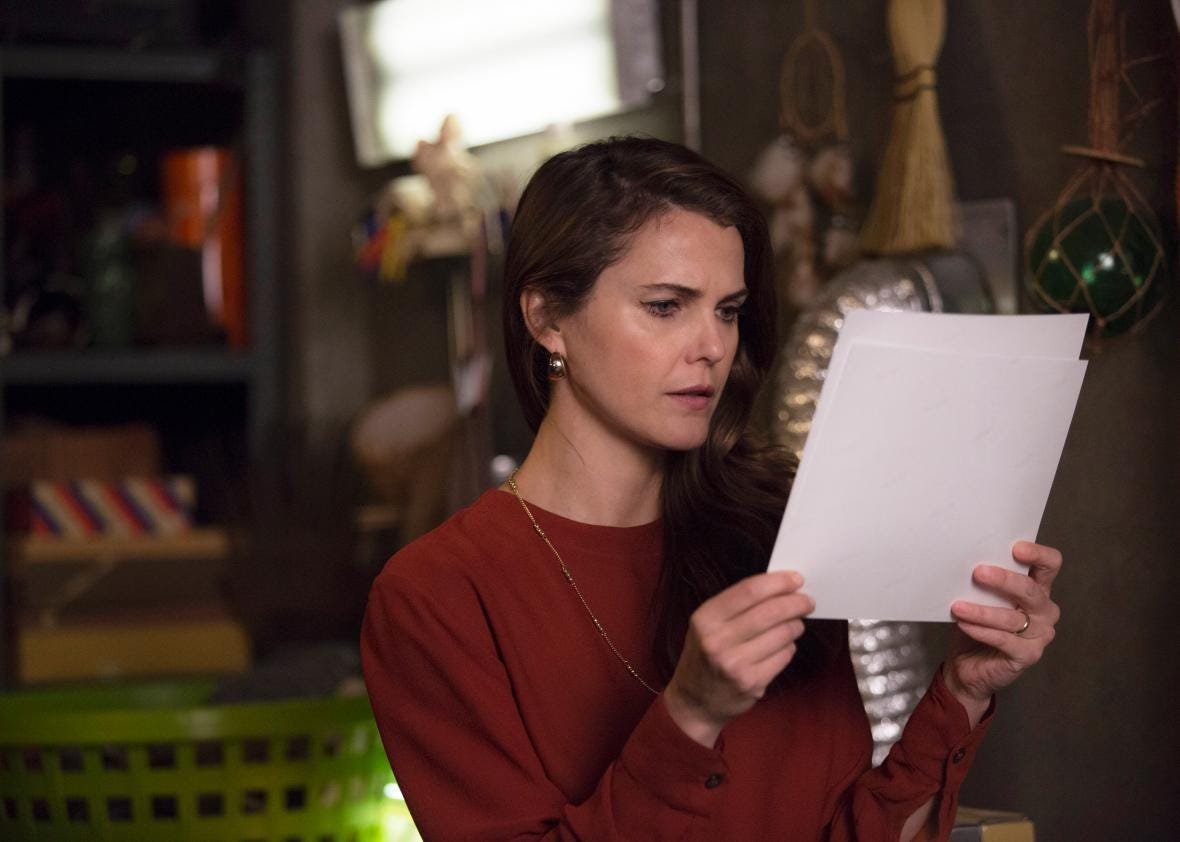
Their marriage survives these slings and arrows because their marriage is hard, because marriage is hard. But because The Americans begins with the premise that their marriage is a cover, it spends less time documenting its pitfalls than its promise. The subterranean tenderness that builds over time. That dwells in the knowing glance, in a long silence. How intimacy and love can grow from duty. Sprigs flowering around cold rails. The all-consuming nature of a fight with a spouse followed by the tenderness of reconciliation. Joint suffering over children, work. That thing where wives sometimes just know what their husbands need, how they grasp them in a moment of vulnerability and love them despite whatever feuding might trail them. The Jennings’ small acts — gestures, looks — of marital love are the sparks that sustain the show. In the final episode of Season 5, Elizabeth tells a young protege that he will fail in the spy business without a partner. She could have been talking about life. You need someone to get through the vicissitudes of life. And there is no institution formidable enough for that task than marriage. The Americans is a story about marriage dressed up as a spy thriller. The show’s heart isn’t into all the Soviet plot machinations. The tribulations of Elizabeth and Philip’s marriage is the beating heart of the show.
That, and friendship. Noah Emmerich makes for a superb Stan Beeman, their lonely FBI neighbour. Surely the greatest friendship heartbreak on TV. “I would have done anything for you Philip,” he tells Philip in their final confrontation, and I dare you not to choke up. They were best friends, ruse or no ruse. (Funny that Emmerich plays the fake best friend in the greatest film of fakery, The Truman Show.) It’s in these moments that the show reaches the heights of TV, Beeman left standing alone, his silhouette against an empty car park, stewing in his heartbreak, without his best friend, Dire Straits’ Brothers in Arms strumming in the background.1
The Americans is also surprisingly ambitious in its form. Lured into watching a show about an American-as-apple-pie couple with a big secret, you end up watching a show half set in Russia and in Russian. An underappreciated forerunner to Shōgun, a genuine American masterpiece that’s somehow largely in Japanese.
Like all shows about people in middle life The Americans is about the crises of middle life. Dealing with kids growing up. Raising them in a foreign land, and figuring out how to impart what matters about your own culture — inevitably to some degree of failure. Marital turbulence. Career anxiety. The Jennings just have to deal with spy issues too, like fake second marriages and coups and handling stolen bioweapons.
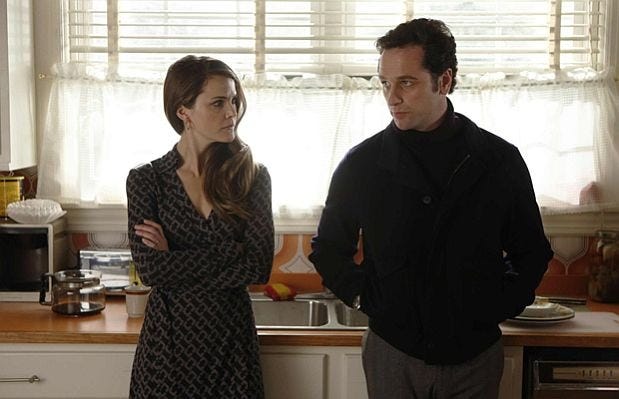
What happens when the mask becomes the face? The Jennings really do become an American family. Their kids are American. Breaking up with or being dumped by a fake girlfriend turns out to suck as much as the real thing. The fake becomes the real. What is fake and real anyway? There is just what we do in this world. A fake marriage turns out to be indistinguishable from a real marriage. A fake travel business takes as much work and is as prone to failure as a real travel business. A fake friendship contains the same love and potential for loss as a real one. Take Philip’s fake second marriage to Martha, the FBI secretary. She stays loyal to him even after she uncovers the ruse. And he stays loyal to her. In an effort that strains credulity, they whisk all-American Martha out of the US and away from all she’s ever known to start again in the Soviet Union. This would be laughable in The Sopranos universe, where she’d have been lucky to get a bullet to the back of the head. Philip’s devotion to her, pushed to the limits of what he can do, is apparent to even Elizabeth, who in a rare moment of vulnerability tells him she understands if he would rather stay with Martha. But no. Philip’s ultimate loyalty lies with Elizabeth, his fake-cum-real wife.
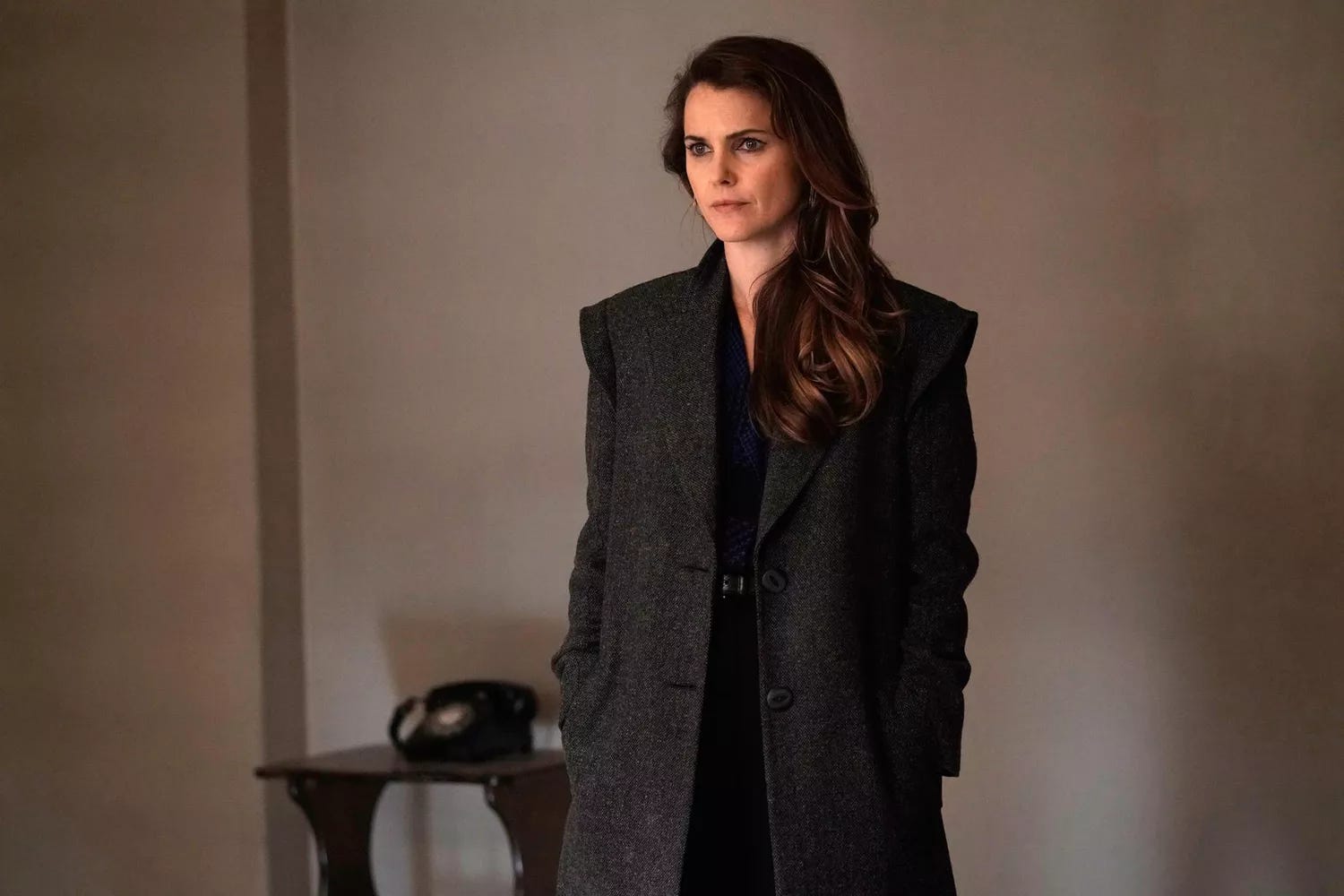
And then there’s Keri Russell, who plays Elizabeth Jennings. They could have just called it the Keri Russell Show. Probably the greatest female lead in television history, although I may just be smitten by the line of her neck. She’s mesmerising. Tough as guts. Reminds me of my wife. Elizabeth is an apt paean to the wife. In her many guises she is fun, sexy. But she is most mesmerising in stillness. A stern, pained, or loving look. A thousand words in a glance. In the same way horror closeups of Elizabeth Moss’s horror-face augmented the horror of Gilead in A Handmaid’s Tale, Keri Russell’s steely wife’s love is the north star to every lost boy. She embodies the show’s idea of marriage — discipline, loyalty, and endurance. Something to hold onto in a harsh world.
The Americans doesn’t pull its punches. Senseless murders, sexual escapades, rapes, dismemberments — there is an endless procession of gore and titillation. And yet its range is far more limited than its predecessor, The Sopranos. Everyone in The Americans is too competent. Too nobly intended even. Adverse selection rules everything in The Sopranos. Its thugs brutalise everyone around them out of malice and incompetence in equal measure — that’s part of the general tragedy, the decay in everything. The Sopranos is a Great American tale, spanning farce and piercing insight into the human condition: fatherhood, marriage, civilisational decline, all through the eyes of New Jersey mobsters. The Americans dabbles in darkness but doesn’t really descend into it. Things seldom go to plan, Elizabeth tells her apprenticed daughter. But mainly they kind of do. How much competence can we really believe in the state security services of an indolent late-stage Soviet Union, or a decadent Reaganite FBI? But that competence is necessary for the tension of the show. Beside The Sopranos, which wallows in its darkness, The Americans is pristine.
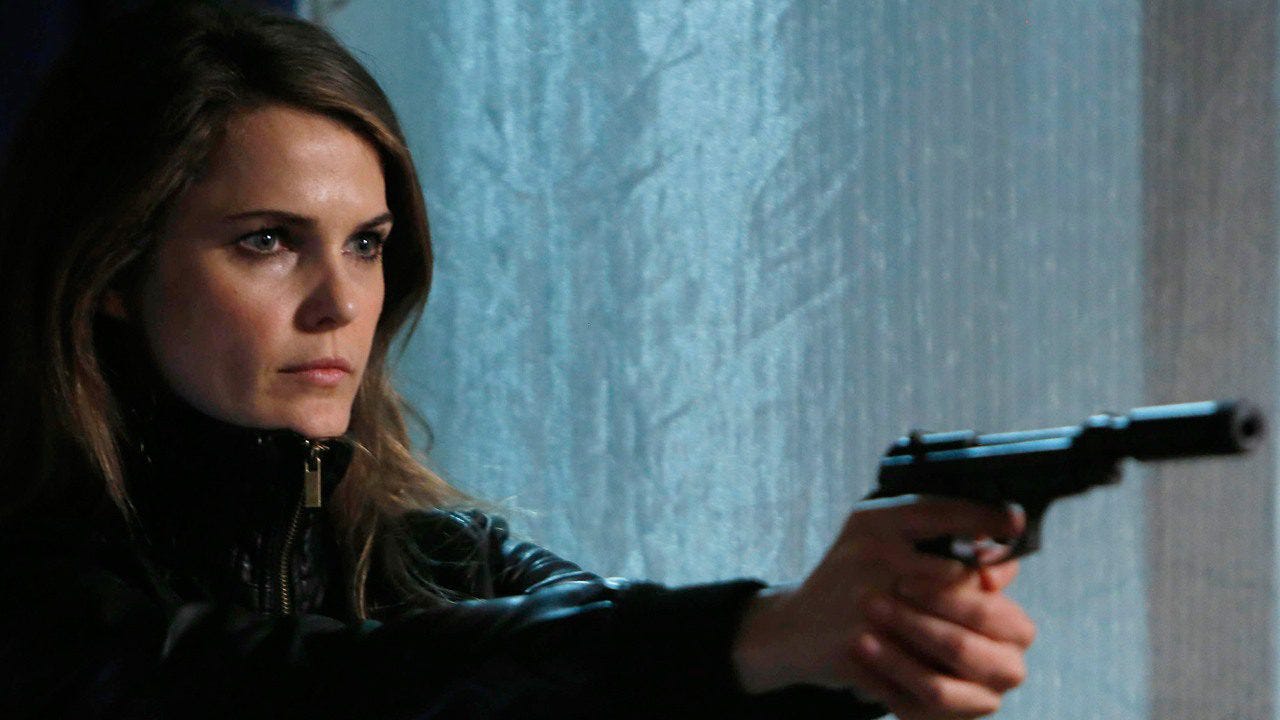
The Americans is relentlessly anti-Soviet. Our hero agents kill innocents. Characters recall evils committed by Soviets to each other. A KGB’s officer’s mother was imprisoned at a camp and sold herself for food. Elizabeth was raped. I recall only one moment in the entire show where there is an honest compliment paid to the USSR. A dissident — who hates the Soviet Union — says, America has food and money but it’s not so easy to be happy. He misses his street, his home, his friends. That’s the only moment in six seasons the show pushes back on Reaganite America. Easy to be sympathetic with that posture. But wouldn’t it have been more powerful for the show to undermine some of America’s sheen? The Wire was set 15 years later. Show the real streets of Baltimore — the Jennings live in DC! But that kind of moral exploration (nihilism?) lies outside of the show’s narrow aperture.
The show deftly gets at deep cultural fissures through cultural misunderstandings. Reagan’s assassination attempt is immediately perceived by the Soviets as a military coup. Obvious to a Soviet cynic, absurd to an American. American crop testing to create bug resistant wheat is misconstrued by the Soviets as a pest to cause mass famine. The show correctly gleans a cynical glint to the Soviet eye; suspicion where it is unjustified, and a projection of its own vast malice.
The ending is satisfying and emotionally intense, but the emotional nadir of the show comes late in the penultimate season. Our heroes are asked to hunt down a Nazi collaborator, living under false pretenses in the US. Their righteous crusade becomes morally muddied. Turns out their collaborator had been sixteen. Her family had been shot around her. The Germans got her drunk and made her shoot Soviet prisoners. She had made a decent life since — the American dream. Philip hesitates and Elizabeth guns her down, along with her loving American husband. It’s a brutal scene. Even the Soviets’ righteous crusades become grotesque abortions.
The emotional thread that runs through the series is the couple’s slow disenchantment with their mission. They’re constantly running into ‘are we the bad guys’ dilemmas. Like their disguises, their little evils decorate the show. Knifing dissidents and leaving them to be found by their young son. Encouraging a dissident’s teenager to suicide. Seducing an underage daughter of a CIA operative. Innocents killed as collateral damage. They try to steelman their revolutionary zeal and their communist comrades, but it’s difficult, especially by the 1980s when the Soviet functionaries themselves are stripped of most idealism and are soaked in cynicism. They see the opulence in the America around them, and compare it to the scarcity back home. Once they could have excused this for the terrible burden shouldered by the Soviets during the Great Patriotic War. By the late Soviet era that excuse rings hollow. One dissident they ‘befriend’ complains constantly about the lack of freedoms and other evils that travailed him in the USSR, grating against their idealisation of life back home. As their faith in communism frays, their faith in their marriage grows. It’s too late for them to stay in America. But back home where they end up — unbeknownst to them ahead of total collapse — they have each other.
The Americans steps up its music game in the last season, and especially the last episode. Just like The Sopranos nailed its ending with Journey’s Don’t Stop Believin’, U2’s With or Without You plays to the Jennings’ final moments in America as their family and their world unravels. Are they allowed to just claim a banger like that? Almost cheating, frankly. Between the couple and their abandoned children, between them and the dying USSR, they can’t live with or without any of it.
The Americans dissolves the line between real and fake, but not the line between meaning and a joke. “You made my life a joke,” Stan tells Philip in their final confrontation. “My life was the joke,” Philip responds. Philip and Elizabeth fought for a hollow cause, for false masters. They lost their children, who will now hate them as they pick up the pieces of their lives. (“You’re a whore,” her daughter tells Elizabeth, the full extent of her mother’s professional philandering dawning upon her.) What was it all for? What is any of it for? What’s left? Each other. They still raised their two kids to adulthood. “They'll remember us. They're not kids anymore. We raised them,” Philip tells Elizabeth in the final scene. And the friendship with Stan? Despite everything, it was real. Not everything is eternal. Broken things can have had meaning too.
For a brutal dissection of their final scene, I recommend the annoyingly excellent Emily Nussbaum.
Your wife is extremely hot.
You forgot the very best tidbit about this show: Keri Russell and Matthew Rhys started dating while working on it.